

For most oversized windows, the smartest large window treatments come down to four families: cellular shades for insulation, motorized roller or panel track systems for wide spans and sliding doors, and custom drapery on reinforced hardware for a finished, formal look. Shutters work well up to a point but lose practicality on very wide openings. Before ordering anything, measure carefully or book a free in-home consultation with a professional who can check your hardware and mounting surface.
TL;DR:
- Oversized windows should be treated with custom solutions like multiple cellular shades or panel track systems rather than standard single shades to prevent sagging and uneven operation.
- Proper measurement, hardware reinforcement, and professional consultation are crucial to ensure fit, function, and safety, especially for windows wider than 40 to 48 inches.
- Motorized systems are essential for large or tall windows to ensure even tension, safety, and ease of operation, with power options including hardwired, battery, or solar-assisted.
- Layering window treatments, such as combining shades with drapery, enhances aesthetics and insulation, but full fullness and appropriate design styles are vital for proportionate, balanced look.
- Large windows can lose up to 30% of home energy, making cellular shades and layered insulation strategies highly effective for energy efficiency.
Table of Contents
- Which Large Window Treatment Fits Your Situation?
- How Do Different Treatment Types Perform on Big Windows?
- How Do You Measure and Size Hardware for Large Windows?
- Is Motorization Worth It for Large Windows?
- Why Does Professional Measurement Matter More on Oversized Windows?
- How Do You Style Large Windows Without Overwhelming the Room?
- How Much Energy Do Large Windows Really Lose?
- What Safety and Maintenance Steps Do Large Windows Need?
- Why a Professional In-Home Consult Solves Most Large-Window Headaches
- Get a Free In-Home Consultation for Your Large Windows
- Sources
- FAQ
Which Large Window Treatment Fits Your Situation?
Not every big window has the same problem to solve. A wall of glass facing a wooded backyard needs something different than an 8-foot slider off the kitchen or a two-story great room window nobody can reach with a step stool. Matching the treatment family to the actual use case saves you from buying the wrong system and redoing it a year later.
Here’s how the most common large-window situations tend to sort out:
- Wide picture windows or window walls: Cellular shades or roller shades, often motorized, handle these best. They stack cleanly and manage glare without competing with the view.
- Sliding glass or patio doors: Panel track systems are purpose-built for this. They glide along a track the same way the door does, so operation feels natural.
- Floor-to-ceiling or two-story windows: Motorized lift is close to essential here. Manual cords or wands on a 10 or 12-foot drop are awkward and, frankly, unsafe to operate from a ladder.
- Multi-panel or bay configurations: Drapery on a traversing rod, or shutters sized per panel, keeps the proportions balanced instead of visually chopping the wall into segments.
- Formal living or dining rooms: Custom drapery with proper fullness gives the room the finished, tailored look that a stock shade alone won’t deliver.
Each family trades off differently on operation, visual scale, insulation, and upkeep. Cellular shades win on energy performance but add less architectural drama. Drapery wins on formality and softness but needs more planning around fullness and hardware. Panel tracks solve the “how do I even cover this” problem for sliders but read more casual than drapery. Shutters bring permanence and resale value but get heavy and expensive fast once a single window pushes past roughly 40 to 48 inches wide.
If your window falls within standard proportions and matches an off-the-shelf width tier, an adjustable ready-made system can work. Anything wider than a typical patio door, taller than 8 feet, or oddly proportioned almost always performs and looks better as a custom order, built for that exact opening rather than trimmed down from a stock size.
How Do Different Treatment Types Perform on Big Windows?
Big windows don’t just need a bigger version of a standard treatment. Fabric behaves differently at scale, hardware has to work harder, and a small measuring error that would be invisible on a 30-inch window becomes an obvious sag or gap on a 10-foot span. Here’s what actually happens with each treatment family once you cross into oversized territory.
Cellular (honeycomb) shades
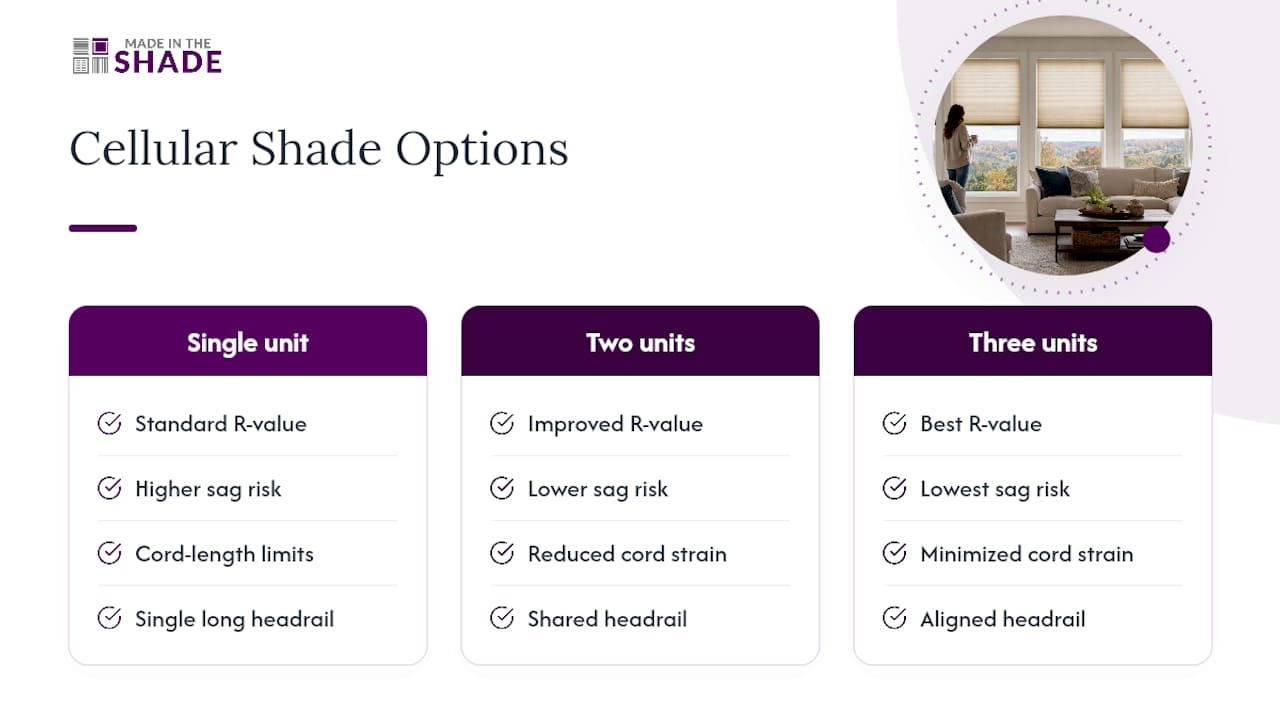
Cellular shades trap air in their honeycomb pockets, which is why they carry a meaningfully better R-value than a flat roller or vinyl blind. On a large window, that insulating layer matters more, not less, because there’s simply more glass losing heat. Single-unit cellular shades typically top out in the range most manufacturers rate for standard-to-wide openings before sag and cord-length limits kick in; beyond that, the better approach is splitting the opening into two or three units mounted on a shared or aligned headrail. The fabric itself is lightweight, which helps at scale. A heavy fabric on a wide cellular shade adds strain to the lift mechanism that a light, pleated cellular material simply doesn’t create.
Motorized roller shades
Roller shades scale well for wide windows, but only when the tube gauge and motor torque are matched to the width and fabric weight. A thin-walled tube that works fine at 36 inches will visibly bow in the middle at 96 inches. Manufacturers build roller systems in width tiers, and once you cross into the widest tier, motorized shades for large windows typically require a heavier-gauge tube and often a center support bracket to prevent deflection. Motorization isn’t just a convenience feature here. A manual chain system on a wide roller gets pulled unevenly over time, which is one of the more common causes of premature wear on oversized shades. Even tension from a motor protects the investment.
Panel track systems
Panel tracks exist specifically for openings a single shade or drapery panel can’t handle gracefully, which is why they’re the default recommendation for sliding glass doors and wide walls. Instead of one wide piece of fabric, the opening is divided into multiple panels that glide along a track, distributing weight across several smaller pieces rather than one oversized one. This is part of why panel track systems handle very wide openings more reliably than a single-span alternative would. You can order panels in woven textures, blackout fabric, or sheer material, which makes panel track more versatile than people expect. It’s not just a utilitarian solution for a sliding door. It can look intentional and layered when the fabric choice is right.
Vertical blinds and vinyl alternatives
Vertical blinds get dismissed as dated, but for certain rooms they still make practical sense. Bathrooms, sunrooms, and rooms with high moisture or grease exposure benefit from vinyl or PVC verticals because they wipe clean and don’t absorb humidity the way woven fabric can. Budget matters too. If you’re covering a large sliding door on a tighter budget, a vinyl vertical will cost less than a woven panel track system while still solving the same operational problem. The tradeoff is aesthetic. Vinyl verticals rarely read as high-end, so they’re a better fit for utility spaces than formal living areas.
Custom drapery
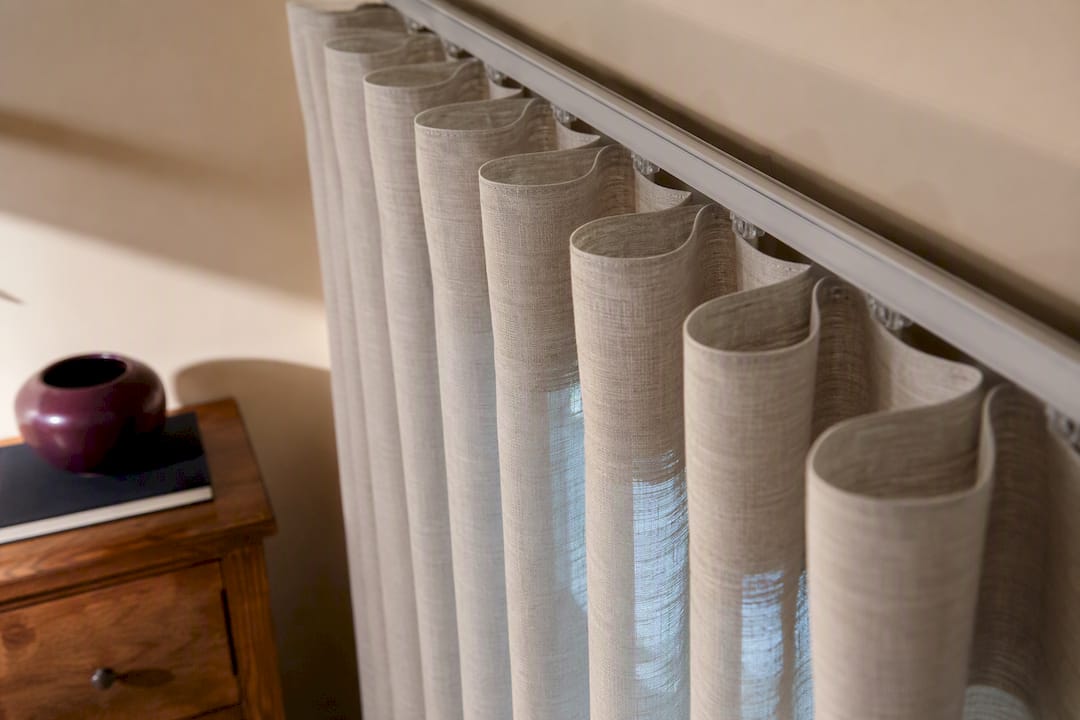
This is where fullness ratio decisions make or break the finished look. Drapery fullness guidance generally recommends 1.5 times the window width for a lean, contemporary look, and up to 2.5 times for a richer, more traditional appearance. Skimp on fullness across a wide window and the drapery reads thin and flat no matter how nice the fabric is. Pleat style matters too. Pinch pleat and goblet pleat suit traditional rooms, while ripplefold has become the go-to for large modern openings because it creates a clean, even wave without heavy pleats bunching up the fabric. For very wide spans, a traversing or ripplefold track system lets the drapery glide smoothly rather than dragging on a static rod, which becomes a real issue once a panel gets wide and heavy.
Shutters
Shutters bring a solid, architectural look that few other treatments match, and they hold up well on standard-to-large windows. The catch is width. Once a single shutter panel needs to span much beyond 40 to 48 inches, the panels get heavy, hinges get stressed, and the cost climbs quickly because wide panels typically require additional panels and hardware to operate smoothly. On a genuinely oversized window, like an 8-foot picture window, shutters can still work, but they usually need to be broken into multiple panel sets, which changes the visual proportions from what you’d get on a smaller window.
- Identify the primary function you need: insulation, glare control, privacy, or pure aesthetics.
- Match that function to a treatment family using the categories above.
- Confirm the width falls within that family’s standard tier or plan for a split/multi-panel approach.
- Choose fabric or material based on the room’s moisture, light, and maintenance needs.
- Get a professional measurement before finalizing hardware or fullness.
Pro Tip: If you’re torn between two treatment families, think about which one fails more gracefully. A slightly-too-thin drapery panel just looks a little flat. A roller shade with an undersized tube on a wide window will sag, bind, or wear out early. When in doubt, prioritize the mechanical solution over the purely decorative one.
How Do You Measure and Size Hardware for Large Windows?
Oversized projects punish measuring shortcuts. A quarter-inch error on a standard window is forgiving. The same error across a 10-foot span can throw off fabric fullness, cause binding, or leave gaps at the edges that are impossible to hide.
- Measure width at three points, top, middle, and bottom, since older homes and additions rarely have perfectly square openings. Use the smallest measurement for inside-mount treatments and the largest for outside-mount treatments.
- Measure height from the mounting surface down to the sill or floor, and add allowance for overlap so light doesn’t leak around the edges of the treatment.
- Decide early whether a single wide unit is realistic. Fabric weight and tube sag thresholds determine whether one continuous shade works or whether the window needs to be split into two or three units on a shared headrail.
- Confirm hardware specifics with your installer: heavy-gauge tubes, center support brackets, and reinforced mounting brackets are common requirements once a window crosses into oversized territory, and professional measurement for oversized treatments is one of the most consistent recommendations across the industry for exactly this reason.
- Always ask whether structural backing is needed for ceiling mounts, especially on drywall or plaster substrates that weren’t built to carry heavy drapery hardware.
Skipping any of these steps is how homeowners end up with a beautiful shade that sags in the middle within six months.
Is Motorization Worth It for Large Windows?
Motorization stops being a luxury add-on once a window gets big enough that manual operation becomes a chore or a safety issue. Uneven manual pulling is one of the leading causes of premature hardware wear on wide shades, and a motor eliminates that problem by applying even tension every time. For windows that are simply too tall or too high to reach safely, a remote or app-based control solves an access problem that no amount of manual hardware upgrades will fix.
Power options break down into three categories:
- Hardwired: The most reliable option for permanent installations, especially in new construction or during a renovation where wiring can be run before walls close up.
- Battery-powered: Rechargeable battery packs work well for retrofits where running wire isn’t practical, though they need periodic recharging depending on how often the shades cycle.
- Solar-assisted: A small solar panel keeps the battery topped off, which suits south-facing windows with strong sun exposure throughout the Philadelphia suburbs’ longer summer days.
Before ordering, confirm the motor brand works with the smart-home ecosystem you actually use. Smart, motorized window shades that integrate with Alexa, Google Home, or Apple HomeKit let you schedule shades to close during peak afternoon sun or open automatically at sunrise, which is a genuinely useful feature on large west or south-facing exposures.
Pro Tip: Ask about motor compatibility during your consultation, not after your order is placed. Swapping a motor brand later usually means replacing the whole headrail, not just reprogramming a remote.
Why Does Professional Measurement Matter More on Oversized Windows?
DIY measuring mistakes that would go unnoticed on a small window become glaring on a large one. Poor fullness reads as flat and cheap. A mount chosen without checking clearance leads to a shade that hits window cranks or handles. Skipping center supports on a wide roller shade means watching it sag within months, and by then, the fabric is already cut and the returns window has closed.
A professional in-home consultation typically includes:
- Sample drapes or shade mockups held up against the actual window so you see scale and light behavior in your own room, not a showroom.
- A substrate check to confirm the wall or ceiling can support the hardware weight, particularly for heavy drapery rods or motorized headrails.
- Stackback planning, meaning how much wall space the treatment needs when fully open, which matters enormously on wide sliders and picture windows.
- A backup plan. If a single-unit shade isn’t feasible given the fabric and width, oversized window treatment projects often move to a split configuration or shared headrail as the more durable long-term solution.
Before your consultation, take photos of the window from a few angles, jot down rough measurements, and note where furniture sits so the stackback conversation is grounded in your actual room, not guesswork.
How Do You Style Large Windows Without Overwhelming the Room?
Scale is the whole game with big windows. Mount hardware a few inches wider than the window frame and closer to the ceiling than the top of the glass to complement elegant openings with glass interior doors that enhance your home’s style. This makes the opening look taller and more intentional rather than boxed in. Design guidance for large windows consistently points to mounting higher and wider as one of the simplest ways to make a room feel larger overall.
- Choose ripplefold or simple pleat styles for contemporary rooms; save pinch pleat or goblet pleat for traditional or formal spaces.
- Layer a functional shade underneath drapery. The shade handles glare and privacy day to day, while the drapery adds softness, insulation, and a finished frame around the window.
- Favor natural woven textures and lighter-weight fabrics in casual living spaces. Heavy velvet or thick blackout material can visually overwhelm a large opening in a relaxed room.
- If your ceilings run especially tall, consider how the window treatment interacts with the rest of the wall. Tall spaces read best when hardware and fabric proportions scale with the room, not just the glass.
How Much Energy Do Large Windows Really Lose?
Windows can account for up to 30% of a home’s heating and cooling energy loss, and that number only gets more relevant as the glass gets bigger. A wall of single-pane or older double-pane glass is a significant source of drafts in January and unwanted heat gain in July.
Cellular shades address this directly. Their honeycomb structure traps insulating air pockets, improving the effective R-value of the window without replacing the glass itself. For especially large or exposed windows, interlining drapery or layering a cellular shade underneath drapery adds another barrier. Automated, timed shading helps too: closing shades automatically during peak afternoon sun keeps the HVAC system from fighting against solar heat gain during the hottest part of the day, which matters on Bucks County’s sun-facing rooms through a long, humid summer.
What Safety and Maintenance Steps Do Large Windows Need?
Big windows often mean long cords, which is exactly the wrong combination for homes with young children or pets. Cordless or motorized lift systems remove that risk entirely, and they’re worth prioritizing regardless of how the rest of the treatment is styled.
- Choose cordless or motorized lift systems for any room where children or pets spend time.
- Check brackets and headrails periodically for large or heavy treatments, since hardware under more strain benefits from an occasional inspection.
- Clean according to material: vacuum cellular shades with a brush attachment, spot-clean fabric drapery, and wipe vinyl or faux wood with a damp cloth.
- Keep motorized batteries charged on schedule if you didn’t opt for hardwired power.
- Ask about manufacturer warranties on both the motor and the hardware, along with whether scheduled service visits are available.
Why a Professional In-Home Consult Solves Most Large-Window Headaches
The biggest mistake homeowners make with oversized windows is treating them like a bigger version of a standard window. They aren’t. Fabric weight, hardware strength, and even how light hits the room shift in ways that only become obvious after the wrong shade has been ordered.
Made in the Shade Bucks County brings samples directly into the home, measures the actual opening, and checks the mounting substrate and stackback before anything gets ordered. That in-home step also means factoring in how the Philadelphia suburbs’ seasonal light angles affect fabric choice. A west-facing living room that bakes in July sun needs a different weight and weave than a shaded north-facing bedroom.
The pattern across most large-window projects comes down to three outcomes: a better physical fit than off-the-shelf sizing allows, motorization applied where it genuinely improves daily use, and hardware that’s been reinforced enough to perform for years instead of months. None of that happens by guessing at measurements from a ladder.
— Tony
Get a Free In-Home Consultation for Your Large Windows
Made in the Shade Bucks County is the alternative to guessing your way through an oversized window project. Instead of ordering online and hoping the fullness, width tier, and hardware all line up, a design consultant brings sample collections and measuring tools directly into your home, at no cost, so you see fabric and mechanisms in your own light before committing to anything.

Before your visit, take a few photos of the window from different angles and jot down rough width and height measurements so the consultation moves efficiently. Your consultant will confirm exact dimensions, check the mounting surface, and walk through options ranging from cellular and roller shades to plantation shutters and motorized systems compatible with Alexa and other smart-home platforms. Every project includes professional measurement and installation, backed by manufacturer warranties.
If you’re ready to stop guessing and start planning, schedule your free in-home consultation and get expert guidance on the large window treatments that will actually work in your space.
Sources
FAQ
What type of window treatment is best for a large window?
Cellular shades work best for insulation and energy savings, motorized roller or panel track systems handle wide spans and sliding doors, and custom drapery on reinforced hardware suits formal rooms that want a finished, layered look.
What is the new trend for window coverings in 2026?
Motorized operation, natural woven fabrics, and cordless safety features are the dominant trends, driven by demand for smart-home compatibility and safer options in homes with children and pets.
What type of blinds are best for big windows?
Panel track blinds are generally best for wide sliding doors and expansive openings because they distribute fabric weight across multiple panels instead of straining one continuous span, while motorized roller shades with reinforced tubes work well for wide picture windows.
What are the best blinds for really big windows?
For the widest openings, panel track systems paired with motorization typically perform best, since they avoid the sag and uneven tension that heavy single-span blinds develop over time. A professional in-home consultation with Made in the Shade Bucks County can confirm which configuration fits your exact window width and hardware needs.
How wide can a single motorized shade be before it needs a center support?
It depends on the fabric weight and tube gauge, which is why manufacturers build motorized shades in width tiers and why a professional measurement is the reliable way to confirm whether your window needs a center support bracket.

