

Choose treatments by where the window actually sits. Splash zones near the sink call for wipeable rollers or aluminum. Heat zones near the stove need baked-enamel finishes or film, not hanging fabric. View-preserving picture windows and cozy nooks can handle cellular shades or woven wood. Wherever hands are greasy or reach is limited, cordless or motorized control solves the hygiene and safety problem at once.
TL;DR:
- Wipeable vinyl or aluminum shades are ideal for splash zones, as they are easy to clean and tolerate grease and moisture well.
- Cellular shades provide insulation benefits but should be kept away from high humidity areas like near the stove or sink.
- Motorized, cordless, or child-safe shades are highly recommended to maintain hygiene and safety, especially in high-traffic or household with kids.
- Faux wood blinds and shutters outperform natural wood in moisture resistance and typically last over a decade with minimal maintenance.
- Woven wood shades are best suited for casual dining areas and should be avoided over sinks or stoves to prevent damage from humidity and grease.
Table of Contents
- Kitchen Window Treatment Options at a Glance
- Cellular Shades for Insulation Without the Splash Risk
- Roman Shades and Fabric Rollers: Style That Needs a Dry Spot
- Woven Wood Shades: Texture With a Humidity Catch
- Faux Wood, Shutters, and Aluminum: The Kitchen Workhorses
- Café Curtains and Valances: Decorative Layers Done Right
- How to Choose: A Zone-by-Zone Decision Checklist
- Maintenance and Cleaning Routines That Extend the Life of Kitchen Shades
- Motorization and Child Safety in Kitchen Zones
- How Window Treatments Affect Kitchen Ventilation and Air Quality
- Tony’s Take: What Actually Works in a Philadelphia-Area Kitchen
- Made in the Shade Bucks County Brings the Showroom to Your Kitchen
- Sources
- FAQ
Kitchen Window Treatment Options at a Glance
Not every style belongs in every kitchen. The right kitchen window treatments depend on how close the window sits to water, heat, and grease, and how much light control the room needs. Here’s a fast rundown of the six families worth considering, based on the treatment types most commonly recommended for kitchens by window treatment specialists.
- Cellular (honeycomb) shades – strong insulation, moderate cleanability, best kept away from direct splash.
- Modern roman shades and fabric rollers – high style value, lower cleanability, better for dry, low-traffic windows.
- Vinyl and roller shades – top cleanability, excellent for sink and prep-area windows, wipe clean in seconds.
- Woven wood shades – warm texture, moderate durability, vulnerable to humidity and grease.
- Faux wood blinds and shutters – durable, moisture-resistant, and one of the easiest kitchen window shades to maintain.
- Café curtains and valances – decorative only, best layered over a functional shade rather than used alone.
Motorization fits almost all six, though vinyl, aluminum, and cellular shades pair with motors most naturally because their lift mechanisms tolerate frequent automated cycling.
Cellular Shades for Insulation Without the Splash Risk

Cellular shades trap air in their honeycomb pockets, and that structure is why they outperform flat fabrics on insulation. Single-cell versions offer decent R-value; double- and triple-cell versions trap more air and insulate better, at a higher price and slightly bulkier profile.
They work best in K3 and K4 positions, meaning breakfast nooks and larger picture windows set back from active cooking. Skip them directly above a sink or stove, where steam and grease will eventually dull the pleats.
- Single-cell: lightest insulation boost, easiest to clean
- Double or triple-cell: better energy performance, harder to spot-clean
- Look for performance fabrics rated for moisture resistance if the window sits anywhere near kitchen humidity
For homeowners chasing lower utility bills, cellular shades pull double duty as an energy-saving window treatment as well as a light diffuser.
Roman Shades and Fabric Rollers: Style That Needs a Dry Spot
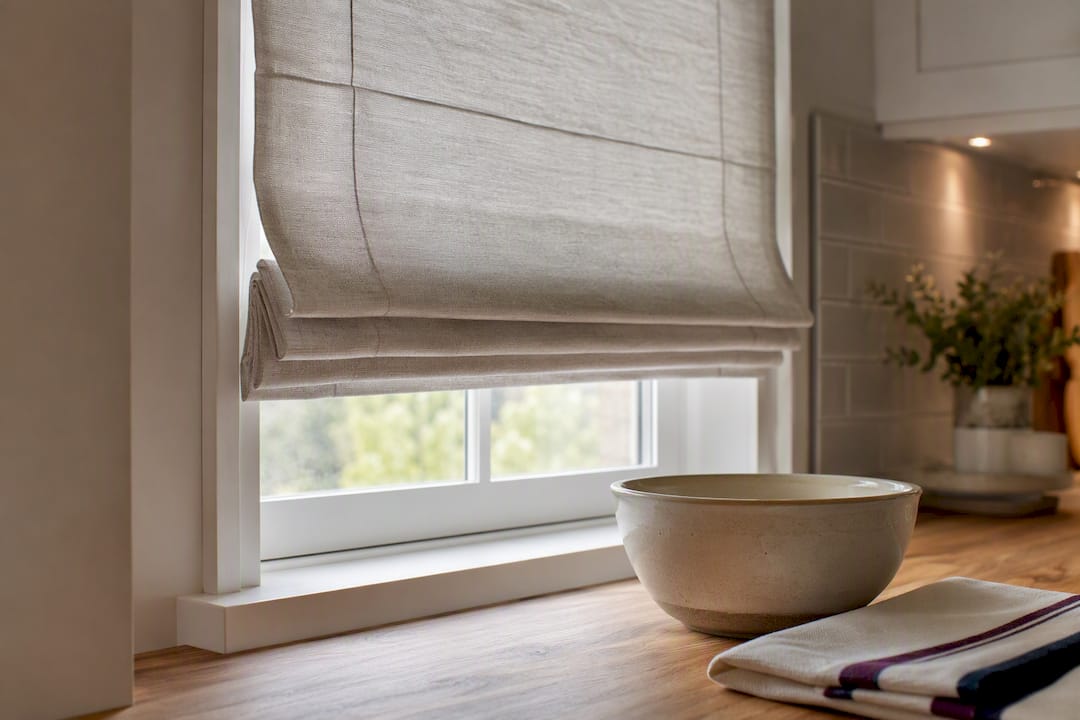
Roman shades and fabric roller shades bring softness that hard materials can’t match, folding into neat horizontal pleats or rolling flat against the glass. They’re some of the most popular decorative kitchen drapes for dining nooks and windows well away from the stove.
Because fabric holds grease and odor, reserve these for low-moisture windows and clean them on a schedule, not just when they look dirty.
- Layer a fabric roman shade over a vinyl or aluminum roller for a look that stays cleanable underneath
- Ask about performance-treated fabrics; even then, plan on professional cleaning every year or two
- Mount outside the window frame when the shade hangs near a countertop, so fabric clears splatter zones and food prep space
Woven Wood Shades: Texture With a Humidity Catch
Woven wood and other natural shades bring a warm, organic look that’s hard to fake with vinyl or metal. Editors regularly highlight woven and café styles for their visual appeal, but the same sources flag them as a poor match for steam-heavy or grease-prone zones.
Save true woven wood for K3 casual dining areas or breakfast nooks, never for windows over a sink or range.
- Choose faux-woven or treated versions when the kitchen runs humid, especially in older Bucks County homes without strong exhaust fans
- Ask about a protective sealant on the weave to resist moisture absorption
- Vacuum monthly with a soft brush attachment rather than wiping, which can fray natural fibers
Faux Wood, Shutters, and Aluminum: The Kitchen Workhorses
Hard-surface treatments handle kitchen abuse better than almost anything else, which is why they dominate recommendations for sink and stove-adjacent windows. Zone-specific guidance consistently points toward these materials for high-splash and high-heat areas.
Baked-enamel aluminum blinds tolerate heat well and belong near ranges, while faux wood blinds and shutters resist warping from humidity better than real wood and suit sink-adjacent windows.
- Keep any slat treatment at least a few inches clear of direct stovetop heat; closer than that, heat-reflective film is the safer call
- Wipe aluminum blinds weekly with a damp cloth; faux wood needs the same, just slightly less often
- Both materials routinely outlast fabric treatments in kitchen use, often for a decade or more with basic care
Homeowners exploring aluminum blinds or faux wood shutters get a treatment built specifically for splash and heat, not adapted from a living-room product.
Café Curtains and Valances: Decorative Layers Done Right
Café curtains and valances deliver the farmhouse or cottage look that a lot of homeowners want, and design galleries consistently feature them as a favorite kitchen window covering idea for half-height privacy over a sink. Architectural Digest has repeatedly showcased café-style layering as a practical styling approach.
- Pair a café curtain with a roller shade underneath so the functional layer handles splash and the fabric handles style
- Mount curtain rods high enough that the fabric never drapes into spray range from the faucet
- Avoid fabric-only coverage directly behind active cooking zones; a valance alone won’t protect against grease
How to Choose: A Zone-by-Zone Decision Checklist
Match the window to its job before matching it to a fabric swatch. Zone-specific thinking, similar to the K1 through K4 framework used in technical buying guides, keeps the decision simple.
- K1, above the sink: vinyl or roller shade, mounted outside the frame for full splash coverage.
- K2, near the stove: baked-enamel aluminum blinds, heat-reflective film, or a motorized roller set well clear of the burners.
- K3, dining nook or breakfast area: woven wood, faux-woven alternatives, or cellular shades for softer light.
- K4, large picture window: solar shades or cellular shades for glare control and insulation without blocking the view.
Before signing off on any option, ask your installer these questions: What’s the IP rating on the motor if it sits near steam? Battery or hardwired power for this location? Does the range hood change airflow or heat exposure at that window? What’s the actual clearance between the shade and the cooktop? Are cordless or child-safe lift options available for this product line?
Pro Tip: If you’re on the fence about motorization, start with just the sink and stove windows. Those two spots see the most hands-on use, so they deliver the biggest hygiene payoff for the smallest investment.
Maintenance and Cleaning Routines That Extend the Life of Kitchen Shades
Cleaning frequency should match how close the treatment sits to grease and steam, not just how dirty it looks. Vinyl and aluminum surfaces wipe clean fastest, which is why buyer’s guides consistently rank them above fabric and natural weaves for kitchen durability.
- Vinyl and aluminum: wipe weekly with a damp microfiber cloth
- Faux wood: wipe weekly to biweekly, same method
- Fabric romans and rollers: dust or vacuum monthly, professionally clean every one to two years
- Woven wood: vacuum monthly with a soft brush, avoid soaking
Cleanability, ranked highest to lowest: roller and vinyl surfaces lead, followed by aluminum, then faux wood, then fabric treatments trailing last.
Watch for warning signs that a treatment is done, not just dirty: a grease smell that won’t wipe away, fabric that’s visibly darkened or yellowed, or slats warping out of alignment. Once any of those show up, replacement usually costs less over time than repeated deep cleaning.
Motorization and Child Safety in Kitchen Zones
The strongest case for motorized shades in a kitchen isn’t convenience, it’s hygiene. Automated lifts mean nobody touches a pull cord or wand with greasy hands, and motorized blinds deliver measurable ROI above sink windows specifically because avoiding manual operation extends the product’s lifespan.
Motorization also unlocks real safety wins. Shades can be programmed to rise automatically during a “cooking mode” scene, or tied into a smoke alarm trigger to lift kitchen shades if smoke is detected. Voice control through Alexa or similar platforms keeps hands off switches entirely.
- Choose battery-powered motors with an IP44 rating for windows exposed to steam, and confirm the charging port carries the same rating
- Hardwired motors suit fixed picture windows where steam exposure is lower
- Cordless lift systems remove strangulation hazards altogether, a point the CPSC emphasizes strongly for households with young children or pets
Pro Tip: Ask about smart-home compatibility before you buy. A motor that only works with its own proprietary app is far less useful than one that plays nicely with Alexa and the rest of your existing setup.
How Window Treatments Affect Kitchen Ventilation and Air Quality
Window coverings do more than block light. They interact with airflow every time a window opens, and that interaction matters more in a kitchen than almost anywhere else in the house.
Heavy fabric treatments, like lined roman shades or thick curtains, can restrict airflow when a window is cracked for ventilation during cooking. That’s a real drawback in kitchens without a strong exhaust fan, since steam and cooking odors need somewhere to go besides the room itself. Hard-surface treatments like blinds and shutters tend to interfere less, since their slats can angle open even while providing some coverage, letting air move past them more freely than a solid fabric panel would.
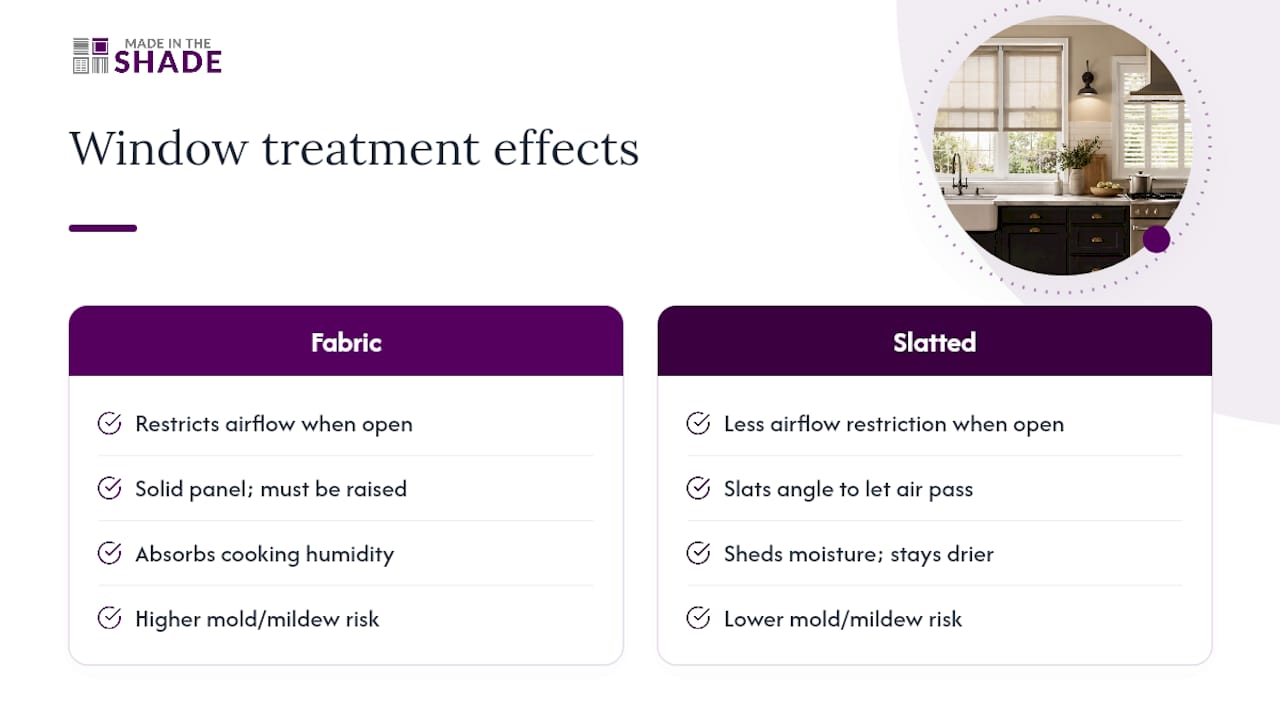
There’s also a moisture side to this equation. Fabric and natural woven treatments absorb ambient humidity from cooking steam, and that trapped moisture can eventually support mold or mildew growth if the window rarely gets a chance to air out. Vinyl, aluminum, and faux wood shed moisture instead of holding it, which keeps the immediate window area drier and less hospitable to mold spores.
For kitchens that rely on the window itself for secondary ventilation, alongside a range hood, a slatted treatment that opens fully out of the way beats a fabric shade that has to be raised and lowered by hand every time. That’s one more reason motorized aluminum or faux wood blinds near a stove earn their keep. They clear out of the airflow path with one tap, rather than sitting bunched at the top and blocking part of the opening.
Tony’s Take: What Actually Works in a Philadelphia-Area Kitchen
Many suburban kitchens share the same layout problem: a sink window that takes a beating and a dining window that just needs to look good. Treat them differently. Older single-pane windows lose real heat in a Pennsylvania winter, so lean toward cellular shades or faux wood there before anything decorative. For motorization or custom shutter fit, get a professional measurement rather than guessing.
— Tony
Made in the Shade Bucks County Brings the Showroom to Your Kitchen
Picking between vinyl, faux wood, cellular, and motorized options is easier when you can hold the actual samples up against your own cabinetry and light. Made in the Shade Bucks County solves that by skipping the showroom entirely: a design consultant brings sample collections directly to your home for a free, no-pressure consultation.

Every consultation covers real measurements, not guesswork, so the faux wood blind or cellular shade you choose fits your window exactly, not approximately. Made in the Shade Bucks County carries motorized and smart-home-compatible shades that work with Alexa and other major platforms, plus cordless, child-safe lift options for kitchens with young kids underfoot. Products come with generous manufacturer warranties, most offering limited lifetime coverage, and every installation is handled by trained professionals rather than a DIY ladder job.
If you’re weighing motorized shades and their real-world cost for a stove or sink window, that’s exactly the kind of question a free in-home consultation is built to answer. Made in the Shade Bucks County serves homeowners throughout Bucks County, PA, and Mercer County, NJ. Schedule your free in-home consultation and get expert eyes on your kitchen windows before you commit to anything.
Sources
- Top 5 Kitchen Window Treatments – Hunter Douglas
- 25 Stylish Kitchen Window Treatment Ideas – Better Homes & Gardens
- Cpsc
- Blindshades
FAQ
What’s the best window treatment above a kitchen sink?
Vinyl or roller shades mounted outside the frame are usually the best choice, since they wipe clean instantly and tolerate splash better than fabric or wood.
How often should kitchen blinds be cleaned?
Wipe vinyl and aluminum weekly, dust or vacuum fabric monthly, and schedule professional fabric cleaning every one to two years depending on how much cooking happens nearby.
Is motorization worth it for kitchen windows?
For sink and stove-adjacent windows, yes: it avoids repeated grease contact with cords or wands and allows automation like raising shades during a cooking mode scene, which extends the product’s usable life.
Are cordless shades really necessary for child safety?
The CPSC specifically recommends cordless coverings over corded ones to remove strangulation risk, making cordless a priority in any kitchen where kids or pets are present.
Can I put fabric curtains near the stove?
It’s best to avoid fabric-only treatments directly behind a stove; heat-reflective film or a heat-tolerant hard-surface treatment kept clear of the burner is the safer choice.

