

Retract a fabric retractable awning once sustained winds hit 20 to 25 mph, and be more conservative with an RV awning, pulling it in well before you reach that range. Gusts do more damage than steady wind, so don’t wait for a forecast to confirm what a sudden shove against the fabric already told you. If your awning is motorized, a wind sensor set to retract automatically is the simplest way to protect it when nobody’s home.
TL;DR:
- Wind gusts, not sustained wind speeds, are the primary risk factor that can damage awnings even if the forecast shows mild conditions.
- Most fabric retractable awnings are safe up to 20 to 25 mph sustained wind, but gusts exceeding this range can cause failure by levering or tearing arms.
- Installation quality, including anchoring into solid structures and proper projection length, significantly influences actual wind resistance, often more than manufacturer ratings.
- Fixed canopies and zip-track screens handle higher wind loads due to their engineering and anchoring, whereas RV and lightweight awnings require more conservative retraction timing.
- Routine checks, automatic wind sensors, and early retraction before storms are key to preventing wind-related damage and extending awning lifespan.
Table of Contents
- What Do Awning Wind Ratings Actually Mean?
- How Wind Ratings And Industry Standards Relate
- Does Your Awning Type Change The Safe Wind Speed?
- How Can You Tell If It’s Too Windy Right Now?
- Installation Choices That Change How Much Wind Your Awning Can Handle
- Your Wind-Season Checklist For Awning Care
- What Installers Know That Spec Sheets Don’t Tell You
- Get A Free In-Home Awning Consultation In Bucks County
- Where To Verify Wind Guidance And Standards
- Sources
- FAQ
What Do Awning Wind Ratings Actually Mean?
Manufacturer wind ratings tell you what a specific product survived in controlled testing, not what your awning can handle bolted to your particular house on a gusty Tuesday in March. Installers and awning guides converge on a rough number for fabric retractable awnings: once sustained wind reaches 20 to 25 mph, it’s time to bring the awning in. That range sits around a Beaufort force 4 to 5, what the National Weather Service describes as a “moderate breeze” that raises dust and loose paper, moving into a “fresh breeze” that sways small trees.
The number that actually breaks awnings isn’t the sustained reading on your weather app. It’s the gust.
A steady 15 mph breeze loads an awning arm evenly, and most fabric awnings shrug it off. A sudden 30 mph gust hits the underside of the fabric like a sail catching wind, and that uplift force can bend arms or tear seams even when the average wind speed for the day looks mild.
- Sustained wind loads the frame gradually and predictably.
- Gusts create a sudden, uneven force that finds the weakest point in the arm or mounting bracket.
- The gap between “sustained” and “gust” readings on a local forecast is often the single most useful number to check before leaving an awning extended.
Statistic Callout: Wind guides and installers repeatedly cite the same practical ceiling of 20 to 25 mph for retractable fabric awnings, and nearly all of them flag gusts, not averages, as the actual failure mode.
How Wind Ratings And Industry Standards Relate

There’s no single U.S. certification standard that every retractable fabric awning must pass before it reaches a homeowner’s patio. What you get instead is manufacturer testing data presented as guidance, which varies by brand, fabric, and frame design. That’s an important distinction: a “rated for 30 mph winds” claim on a product spec sheet reflects a lab condition, not a guarantee for your specific installation.
Europe fills that gap with EN 13561, a comparative framework installers reference even in the U.S. to translate a product’s wind resistance into something concrete:
- Class 1 roughly corresponds to Beaufort force 3, or about 8 to 12 mph.
- Class 2 corresponds to Beaufort force 4, or roughly 13 to 18 mph.
- Class 3, the highest common rating, aligns with Beaufort force 5, around 19 to 24 mph.
Fixed, engineered canopies fall under a different rulebook entirely. ASCE 7 governs structural wind-load calculations for permanent, code-built structures, which is why a bolted aluminum canopy and a retractable fabric awning simply can’t be compared on the same scale.
Does Your Awning Type Change The Safe Wind Speed?
The 20 to 25 mph guideline applies most directly to folding-arm fabric retractables, the style most common on patios and decks across Bucks County and Mercer County homes. That design is also the most vulnerable to wind because the extended arms and open fabric create a lever effect the moment a gust catches it from underneath.
Other awning styles behave differently:
- Fixed or rigid aluminum canopies are built to hold higher wind loads because they’re engineered structures subject to ASCE 7 calculations rather than fabric-and-arm mechanics.
- Pergola-style covers with solid or louvered roofs share that same engineered advantage, especially when anchored into a home’s structural framing.
- Vertical or zip-track screens lock the fabric edges into a track on both sides, which resists billowing and generally tolerates more wind than an open folding-arm design.
- RV awnings deserve the most conservative treatment of the group. Vehicle wake, parking-lot wind tunnels, and a lighter frame mean many RV guides recommend retracting well before 20 mph, especially if you’re near open highway or exposed campground sites.
Knowing which category your awning falls into is the first real step toward setting a sensible personal threshold, and it’s exactly what a wind resistant awning evaluation should address before installation.
How Can You Tell If It’s Too Windy Right Now?
You don’t need a weather station to make a good call. A few quick checks, done in under a minute, will tell you almost everything you need to know.
- Try the umbrella test. If wind would flip or strain a patio umbrella, it’s already too strong for a fabric awning.
- Watch the trees and flags. Small branches swaying steadily and flags standing out fully signal Beaufort force 4 or higher, right at the edge of safe awning weather.
- Check the fabric itself. Rippling or snapping at the front bar means the wind has already found its way underneath.
- Use a phone anemometer app or a basic handheld anemometer if you want a number instead of a guess. They’re inexpensive and surprisingly accurate for backyard use.
- Let a wind sensor do the watching when you’re not home. Sensors mounted on the front bar can trigger automatic retraction, and professionals typically set them conservatively rather than pushing them to a product’s rated maximum.
Pro Tip: If you find yourself debating whether it’s “windy enough” to retract, that hesitation is usually the answer. Bring it in and extend it again once conditions settle.
Installation Choices That Change How Much Wind Your Awning Can Handle
A wind rating on a spec sheet means little if the mounting behind it is weak. The single biggest factor in real-world wind performance isn’t the fabric grade. It’s what the brackets are bolted into.
- Anchor into masonry, brick, or solid framing whenever possible, not into thin siding or stucco alone, which can pull loose under repeated gust loading.
- Shorter projections handle wind better than longer ones, because every additional foot of extension multiplies the leverage force on the arms and mounting brackets. A homeowner in a particularly exposed spot, like an open backyard with no windbreak, may get more reliable performance from a slightly shorter projection paired with a lower pitch.
- Steeper pitch sheds wind more readily than a flat-set awning, which catches gusts like a sail.
- Coastal and river-adjacent homes need corrosion-resistant hardware, since salt air and humidity accelerate wear on brackets and fasteners long before the fabric shows any sign of aging.
Good installation isn’t a footnote to wind resistance. It’s the foundation of it, which is why professional installation matters as much as the product itself.
Your Wind-Season Checklist For Awning Care
A little routine attention prevents most of the damage homeowners blame on “bad luck” during a windstorm.
- Retract at 20 to 25 mph sustained wind for standard fabric retractables, and sooner if gusts are climbing past that number even briefly.
- Retract before storms, not during them. Waiting until wind arrives to head outside and crank an awning closed is how people get hurt.
- Never leave a fabric awning extended unattended overnight unless it’s paired with an automatic wind sensor.
- Inspect arms, brackets, and fabric tension each spring and fall, checking for loose bolts, frayed edges, or sagging joints.
- Lubricate moving joints annually to keep the folding mechanism responding quickly when you need to retract in a hurry.
- Schedule a professional check every couple of years, especially after any storm season that brought sustained high winds through your area.
Pro Tip: Motorized awnings with manual override give you the best of both worlds: automatic protection when you’re away, and the ability to close it yourself the moment a cue like rustling leaves tells you conditions have shifted.
What Installers Know That Spec Sheets Don’t Tell You
The manufacturer’s wind rating on a box is a starting point, not a finish line. What actually determines whether an awning survives its first real storm season is a combination of mounting quality, exposure, and how conservatively the wind sensor gets set.
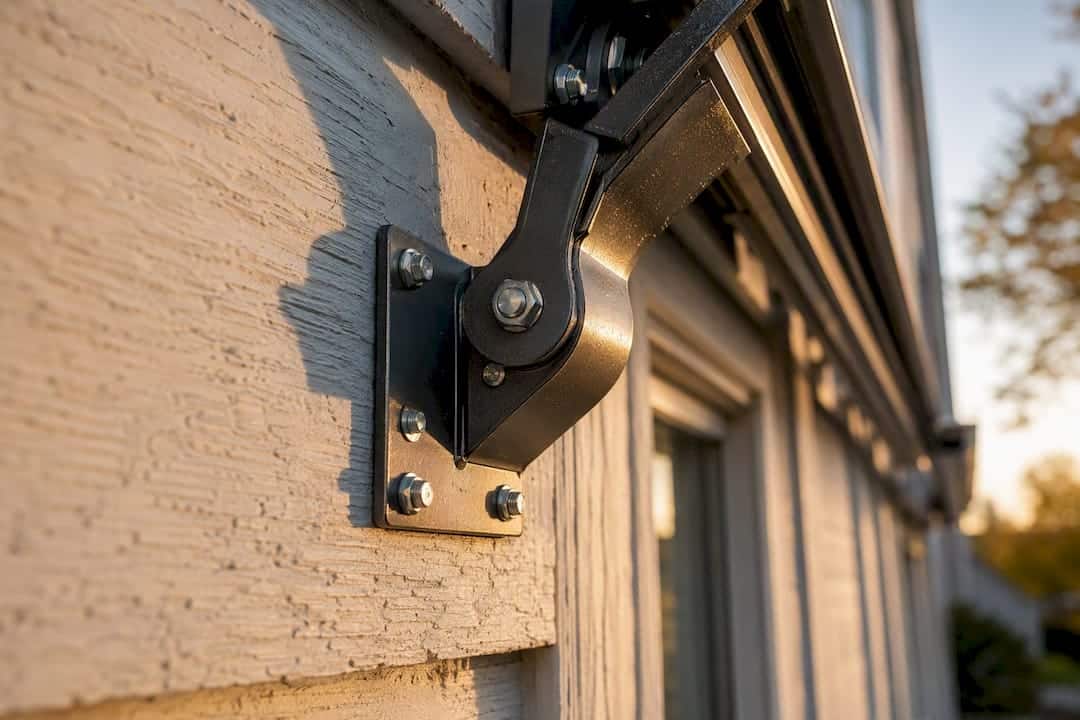
Installers who’ve watched awnings fail almost never point to the fabric as the culprit. They point to a bracket anchored into thin siding, a projection sized too long for an exposed yard, or a sensor threshold set to the manufacturer’s rated maximum instead of a safer number below it. That’s the gap between what a spec sheet promises and what a home actually delivers.
During a free in-home consultation, part of evaluating a home for a retractable awning is walking the exposure: which direction storms typically approach from, whether the mounting wall is masonry or something lighter, and how much unobstructed wind a backyard actually catches compared to a sheltered side yard. That assessment matters more than any number printed on a fabric roll, and it’s the difference between an awning that lasts fifteen years and one that needs arm repairs after its second summer.
Homeowners who treat the manufacturer’s wind figure as gospel are the ones most likely to get surprised. Homeowners who treat it as a starting point, then build in a margin through smart mounting and a conservative sensor setting, are the ones who never think about their awning during a storm at all.
— Tony
Get A Free In-Home Awning Consultation In Bucks County
Made in the Shade Bucks County brings the wind-resistance evaluation to your backyard instead of asking you to guess from a spec sheet in a showroom you’d have to drive to, because there isn’t one. A design consultant measures your exposure, checks what the mounting wall is made of, and walks you through fabric, frame, and motorization options that fit how your specific property catches wind.

Every installation gets anchored into solid structure, not light sheathing, and motorized options are compatible with Alexa and other major smart-home platforms, so an automatic wind sensor can retract your awning the moment gusts climb past a safe threshold, even when you’re not home to watch the forecast. Cordless, child-safe lift options are available for households that want that extra layer of peace of mind. If you’re weighing a retractable awning for a patio in Bucks County or Mercer County, the next step is simple: schedule a free in-home consultation, and get a wind-smart recommendation built around your actual yard, not a generic rating.
Where To Verify Wind Guidance And Standards
For readers who want to check the numbers directly, the National Weather Service’s wind safety page explains Beaufort-scale terms and visual cues. ASCE covers structural wind-load standards for fixed canopies, while BASE Direct’s EN 13561 guide explains European wind classes. Infinity Awnings also offers practical maintenance advice worth a look.
Sources
- Should You Retract Your Awning Before a Storm
- Awnings in Wind & Rain — Weather Guide | AwningTown
- Wind safety | National Weather Service
FAQ
How windy is too windy for an awning?
Most fabric retractable awnings should be retracted once sustained wind reaches 20 to 25 mph, and sooner if gusts are pushing past that range.
What type of awning is best for high winds?
Fixed or rigid aluminum canopies and vertical zip-track screens generally tolerate more wind than open folding-arm fabric retractables, since they’re either engineered structures or have fabric locked into side guides.
Are 20 to 30 mph winds strong?
Yes. That range spans Beaufort force 4 to 5, described by the National Weather Service as a moderate to fresh breeze strong enough to sway small trees and raise loose debris.
At what wind speed should I retract my awning?
Retract a standard fabric retractable awning at 20 to 25 mph sustained wind, and retract an RV awning even earlier, since RV guides generally recommend stowing before reaching that range.
Does a higher manufacturer wind rating guarantee my awning won’t fail?
No. Manufacturer figures reflect controlled testing conditions, not your home’s actual mounting quality or exposure, which is why installation and anchoring matter as much as the rated number.

