

If you want a permanent, view-preserving solution, a neutral solar-control window film handles glare and UV at the glass itself without any daily operation. Cellular shades and blackout roller shades are the better call when you need insulation, presentation-ready darkness, or shift-work sleep.
Your immediate next steps:
- Order fabric swatches and test them at your desk at different times of day before committing.
- If you want professional guidance, samples brought to your home, and accurate measurement, schedule a free in-home consultation with Made in the Shade Bucks County.
Key Takeaways
| Point | Details |
|---|---|
| Openness factor is the key spec | Choose 1%–3% for screen-facing desks; 5%–10% when view matters more than glare control. |
| Film handles what shades can’t | Solar-control film reduces heat and UV continuously, even when the shade is raised. |
| Layering beats either alone | Film as a baseline plus a 3% solar shade gives both continuous protection and daily flexibility. |
| Test swatches before ordering | Hold samples at your window at the worst glare time of day to confirm the fabric works in your actual light. |
| Made in the Shade Bucks County | Free in-home consultations with samples, professional measurement, and installation in Bucks County, PA and Mercer County, NJ. |
Table of Contents
- How do glare-reducing window shades, blinds, and film actually differ?
- Solar shades, roller shades, cellular shades, blinds, and window film: what each one does
- How to choose the right solution for your home office
- How to measure, install, and what it typically costs
- Reading the specs that actually matter: openness factor, VLT, and UV rejection
- How to combine film, shades, motorization, and child-safe options
- Why professional measurement and installation pays off
- Ready to fix your glare problem? Here’s how Made in the Shade Bucks County helps
- Sources
- FAQ
How do glare-reducing window shades, blinds, and film actually differ?
Every window treatment reduces glare differently, and the mechanism determines which trade-offs you accept.
Solar shades use a woven screen fabric with a measured openness factor. The tighter the weave, the less light and glare pass through. They stay down during the day and roll up when you want an unobstructed view. Roller shades with light-filtering fabric work similarly but typically use a denser, more opaque material that softens light rather than filtering it through a screen weave. Cellular (honeycomb) shades trap air in their cells, giving them real insulation value. They reduce glare by blocking direct light, though they sacrifice the view entirely when closed. Blinds let you tilt slats to redirect light toward the ceiling, which can cut direct glare without fully darkening a room. The trade-off: aggressive tilting usually blocks the view, and slats scatter light in ways that can still cause screen washout.
Window film is applied directly to the glass and works continuously, day and night, without any operation. It modifies how much solar energy and visible light the glass transmits. Film can reduce glare, block UV, and preserve the view while remaining low-maintenance. The key trade-off is permanence: film is not easily adjusted when you want full light on a cloudy day.
- Choose an operable shade when glare varies by time of day and you want flexibility.
- Choose film when glare and heat are constant problems and you want a set-it-and-forget-it solution that keeps the view.
- Layer both when a south- or west-facing window delivers intense heat and glare for hours at a stretch.
Pro Tip: Before buying anything, tape a piece of dark window screen fabric (or a solar shade swatch) to your window for a day. If it doesn’t work, you likely need film or a layered approach.
Pro Tip: Blinds are often the first thing homeowners try for glare. They work in a pinch, but tilting slats to block direct sun usually kills the view and still leaves scattered light on your monitor. Solar shades or film almost always perform better for screen-facing desks.
Solar shades, roller shades, cellular shades, blinds, and window film: what each one does
Solar shades
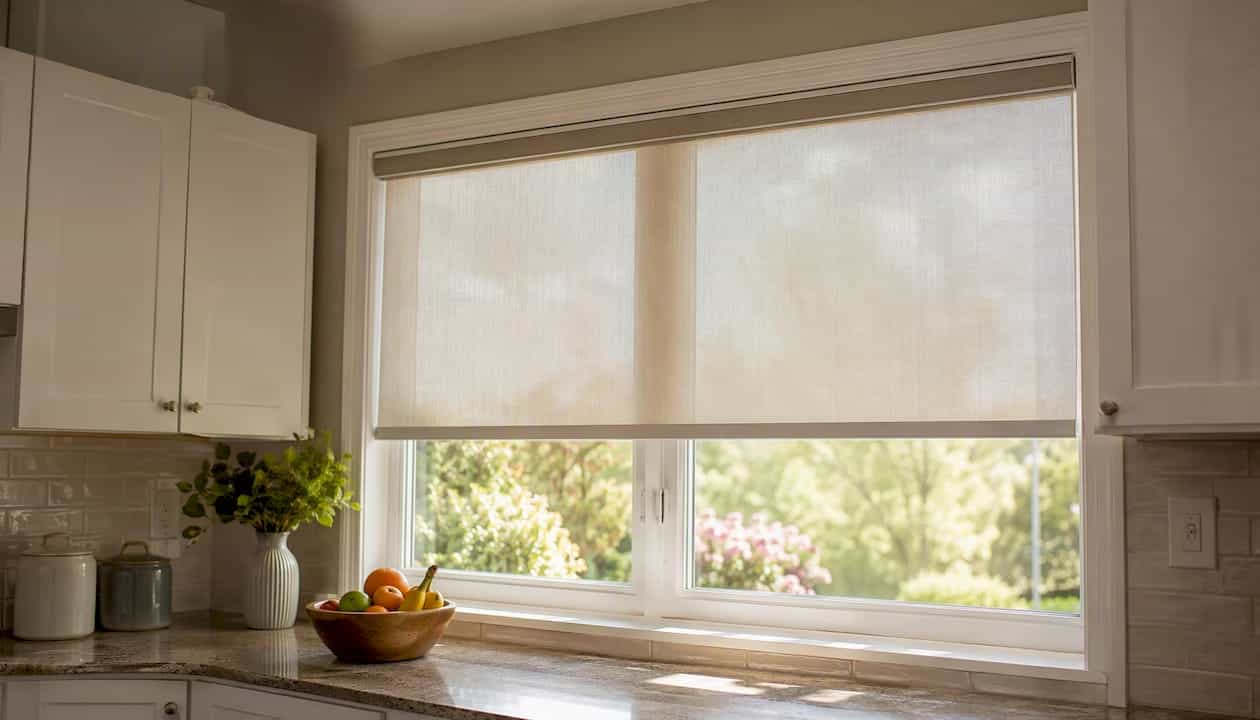
Solar shades are the most purpose-built option for home-office glare. The fabric is a woven screen with a specific openness factor, expressed as a percentage of open area. Lower openness (1%–3%) gives stronger glare control and daytime privacy; higher openness (5%–10%+) preserves view-through with less aggressive glare reduction.
Fabric color matters as much as openness. Darker colors give sharper view clarity through the weave. Lighter colors reflect more heat and make the room feel brighter, but the view looks hazier. Brands like Levolor and Bali both offer solar shade lines with published openness factor specs, so you can compare options directly on the product page.
You can explore the full range of solar shade options to see fabric samples and openness ratings before deciding.
Cellular (honeycomb) shades
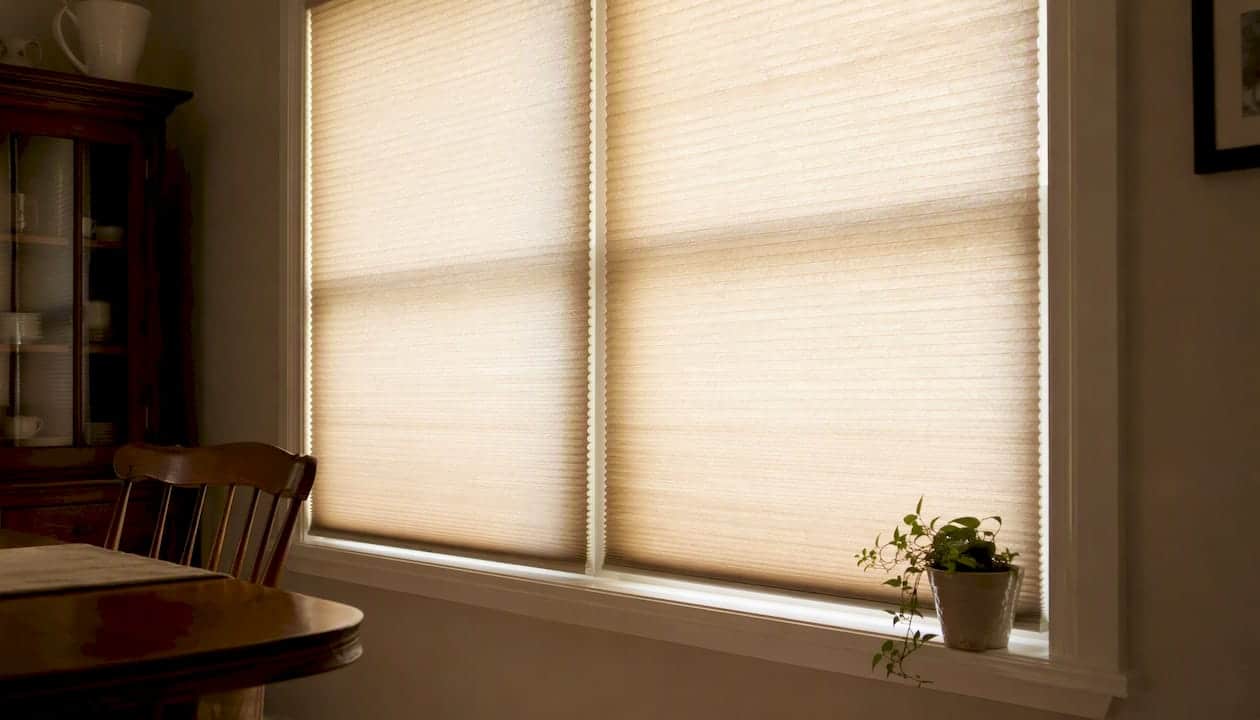
Cellular shades do not use a screen weave. They block light when closed, which controls glare effectively, but you lose the view entirely. Their real advantage is insulation: the honeycomb cells trap air and reduce heat transfer through the glass, which matters in a Bucks County winter or a hot July afternoon. For a bedroom used as a home office, or any room where you need both glare control and energy savings, cellular shades outperform film on insulation. They also work well on north-facing windows where glare is mild and the bigger concern is drafts.
Roller and light-filtering shades
Standard roller shades with light-filtering fabric diffuse incoming light rather than screening it. They soften the room without the view-through quality of a solar shade. For living rooms and bedrooms where you want soft, even light rather than a clear view, they are a practical choice. They are also simpler to operate and generally less expensive than motorized solar shades.
Blinds
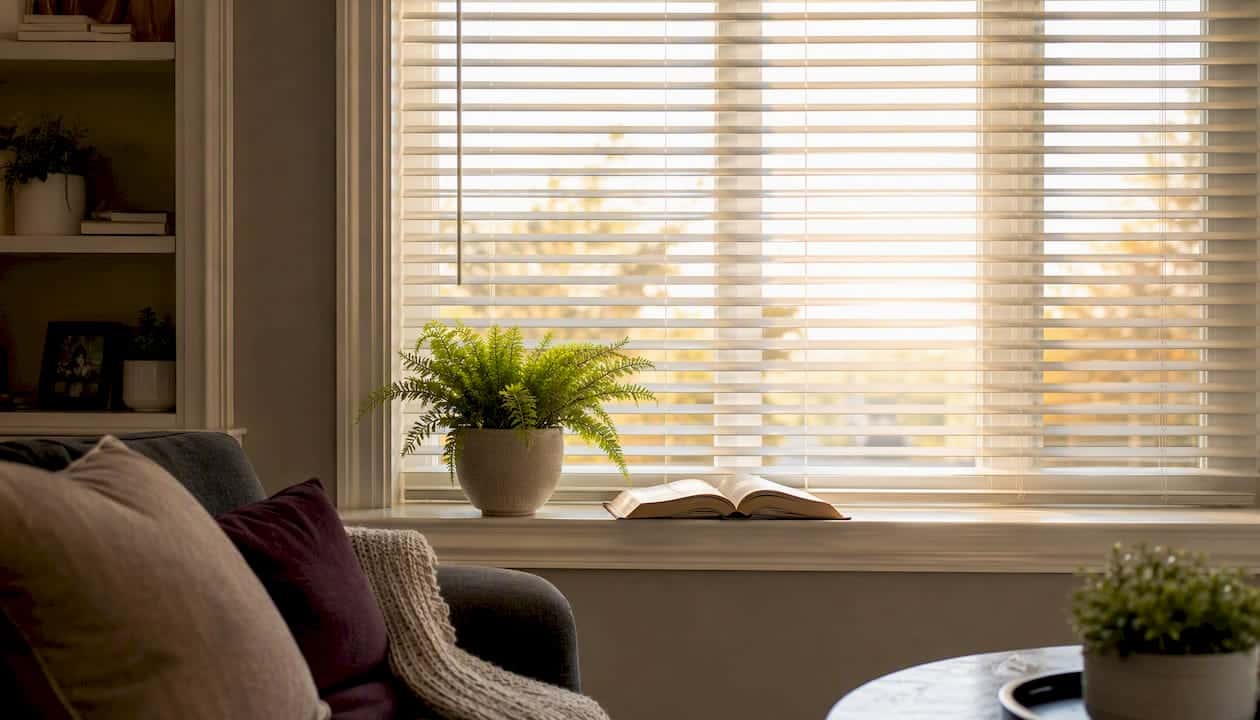
Blinds give you adjustable slat control, which sounds ideal for glare management. In practice, the slat angle that blocks direct sun usually also blocks the view, and scattered light between slats can still wash out a monitor. Blinds work best when glare comes from a low angle and you can tilt slats to redirect light upward. For a dedicated home office with a monitor, most people find solar shades more effective.
Window film
Choosing between film and shades comes down to whether you want an operable solution or a permanent glass upgrade. Film types include solar control film (reduces heat and glare), spectrally selective film (cuts infrared and UV while keeping visible light high), and privacy film (limits view-through from outside). A properly selected film reduces solar load and glare at the glass, often outperforming blinds for heat and fading control while keeping rooms bright. 3M documents glare reduction and UV protection as core film benefits and publishes manufacturer-level performance data homeowners can use to compare options.
Pro Tip: Film is permanent — or at least semi-permanent. If you rent, confirm with your landlord before applying any adhesive film. Removable static-cling films exist but typically perform less well than adhesive versions.
Glare vs. UV: Glare reduction and UV rejection are separate specs. A film or shade can block most UV (which causes furniture fading) while still letting in significant visible light. Always check both figures on the product spec sheet.
How to choose the right solution for your home office
The right anti-glare window treatment depends on four variables: window orientation, desk placement, how much view you want to keep, and whether heat is also a problem.
- Identify your window orientation. East-facing windows deliver morning glare; west-facing windows hit hardest in the afternoon. South-facing windows get sustained sun all day in winter. North-facing windows rarely need aggressive glare control.
- Note when glare is worst. Sit at your desk at the problem times and observe whether the glare comes directly through the glass or reflects off a surface. Direct glare through the glass responds well to solar shades or film. Reflected glare from a light-colored wall or floor may need a different fix.
- Decide how much view you want to keep. If the view matters, solar shades at 3%–5% openness or a spectrally selective film preserve it. If you don’t care about the view, a denser roller shade or cellular shade gives maximum glare control.
- Check whether heat is also a problem. If your west-facing office heats up significantly in the afternoon, film or a cellular shade addresses both issues. Window treatments that reduce solar load also ease the burden on your HVAC system, which matters during a Bucks County summer.
- Consider nighttime privacy. Solar shades with low openness provide daytime privacy (you can see out, but neighbors cannot see in easily). At night, the effect reverses. If nighttime privacy matters, plan for a blackout liner or a dual-roller setup.
Recommended openness factor by exposure:
- East/west-facing, screen-heavy desk: 1%–3%
- South-facing, balanced glare and view: 3%–5%, plus consider film for heat
- North-facing or low-glare rooms: 5%–10%
This combination gives you continuous UV and heat protection plus operational flexibility.
Motorization or a dual-roller setup makes sense when you have multiple windows to manage or when the shade is mounted high enough that manual operation becomes awkward.
Pro Tip: Order swatches from at least two openness levels and two fabric colors. Tape them to your window and check your monitor at 9 AM, noon, and 3 PM. The swatch that eliminates screen reflection at the worst time of day is your answer. No amount of spec-reading replaces this test.
How to measure, install, and what it typically costs
Measuring for shades
- Decide on inside mount or outside mount. Inside mount fits the shade within the window frame for a clean look. Outside mount covers the frame and part of the wall, which blocks more light at the edges and makes a small window appear larger.
- For inside mount: Measure the width at the top, middle, and bottom of the opening. Use the narrowest measurement. Measure the height on the left, center, and right. Use the longest measurement. Most manufacturers deduct a small amount for clearance.
- For outside mount: Measure the width you want the shade to cover (typically 2–4 inches beyond the frame on each side). Measure the height from where you want the shade to mount to where you want it to end.
- For window film: Measure the glass pane only, not the frame. Cut film slightly smaller than the glass to avoid edge lifting.
Installation difficulty
Standard roller and solar shades are manageable DIY projects for a single window with a straightforward frame. Film installation requires clean glass, a squeegee, and patience to avoid bubbles. Motorized shades with hardwired motors need an electrician or an experienced installer. Battery-powered motorized options are simpler but still require precise bracket placement.
Typical cost ranges
Costs vary by product, fabric, and region. As general ballparks: light-filtering roller shades run from around $50–$150 per window for basic materials. Solar shades in branded lines (Levolor, Bali) typically run higher, with custom sizes adding to the cost. Professional window film installation for a standard window generally runs $5–$15 per square foot depending on film type. Motorized shades add $100–$300 or more per window for the motor, depending on the system. Professional measurement and installation adds labor cost but reduces the risk of errors that void warranties.
| Treatment | DIY difficulty | Pro install recommended? |
|---|---|---|
| Solar shade (manual) | Low to moderate | Optional, recommended for large windows |
| Cellular shade (manual) | Low to moderate | Optional |
| Roller shade (manual) | Low | Optional |
| Window film | Moderate to high | Strongly recommended |
| Motorized shade (battery) | Moderate | Recommended |
| Motorized shade (hardwired) | High | Required |
Timeline: From ordering samples to final installation, plan for roughly 3–6 weeks for custom shades (sample review, order, production, scheduling). Film can often be installed within days of ordering.
Pro Tip: Measure twice, order once. A shade that is even 1/4 inch too wide for an inside mount will not fit. If you are not confident in your measurements, a professional measure costs little and prevents an expensive reorder.
Reading the specs that actually matter: openness factor, VLT, and UV rejection
Three numbers appear on nearly every solar shade and film product page. Understanding them prevents expensive mistakes.
Openness factor is the percentage of open area in a solar shade fabric. Lower numbers mean more glare control and more daytime privacy. Higher numbers mean more view-through and more natural light. This is the single most important spec for home-office solar shades.
Visible light transmittance (VLT) measures how much visible light passes through a film or shade, expressed as a percentage. For film, lower VLT means more glare reduction but a darker room. For shades, VLT and openness factor are related but not identical.
UV rejection is the percentage of ultraviolet radiation blocked. UV is the primary cause of furniture and flooring fading, so this spec matters even when glare is your main concern.
When reading warranty language, look for: how long the fabric or film is covered, whether fading or delamination is included, and whether professional installation is required to keep the warranty valid. Most quality solar shades from brands like Levolor and Bali carry limited lifetime warranties on fabric and components. Film warranties from manufacturers like 3M typically cover delamination, bubbling, and color change for a defined period.
For energy-saving window treatments, the combination of high UV rejection and moderate VLT gives the best balance of glare control, furniture protection, and daylight.
Maintenance: Solar shade fabrics can be spot-cleaned with mild soap and water. Avoid soaking the fabric or using abrasive cleaners. Film should be cleaned with a soft cloth and non-ammonia cleaner. Signs a film is failing include bubbling, purple discoloration, or peeling at the edges.
How to combine film, shades, motorization, and child-safe options
Layering is the most effective approach for windows with persistent glare and heat problems.
- Film as a permanent baseline: Apply a spectrally selective or solar-control film to the glass. This handles UV, reduces heat gain, and cuts baseline glare continuously, even when the shade is raised.
- Solar shade for daily control: A 3% solar shade over the film gives you the ability to dial glare down further during peak sun hours and raise it on overcast days. This combination is particularly useful for south- and west-facing home offices in Bucks County, where afternoon sun can be intense from spring through fall.
- Dual-roller setups: A dual-roller bracket holds two shades on one window: typically a solar shade and a blackout shade. This gives you three modes: full daylight (both up), glare control (solar shade down), and full darkness (blackout down).
For layering guidance and sample-based planning, the window treatment layering guide covers the practical combinations in detail.
Motorization is worth considering for any home office with three or more windows, or for windows mounted high enough that manual operation is awkward. Motorized shades from Made in the Shade Bucks County are compatible with Alexa and major smart-home platforms, so you can schedule shades to lower at the same time each morning without touching them. Motorization also reduces wear on the fabric and avoids ladder use for high installations.
Cordless and child-safe lift options eliminate the looped cord hazard. These are strongly recommended in any room where children or pets are present, and they are required under current safety guidelines for child-accessible windows.
Pro Tip: If you are planning both film and shades, install the film first. Film installation requires clean, unobstructed glass access, and having brackets or hardware already in place makes the job harder and risks scratching the film during shade installation.
Why professional measurement and installation pays off
DIY window treatment installation works fine for a single, standard-size window with a manual shade. The risk profile changes quickly when you add film, motorization, large-format glazing, or dual-roller setups.
- Film installation pitfalls: Bubbles, lifting edges, and streaks are common when glass is not cleaned properly before application. Improper prep can also void the film manufacturer’s warranty.
- Shade mounting errors: Uneven brackets cause shades to hang crooked and roll unevenly. Light gaps at the sides of an inside-mount shade are often the result of incorrect width measurement.
- Motorized shade wiring: Hardwired motors require electrical work. Even battery-powered motors need precise bracket alignment for the shade to operate smoothly.
- Warranty implications: Many manufacturers require professional installation to honor the warranty. A DIY install on a premium shade can leave you without coverage if the fabric or mechanism fails.
Made in the Shade Bucks County offers free in-home consultations with trained installers who measure every window before ordering. The consultation includes sample collections brought to your home, so you can test fabrics in your actual room lighting before committing. Motorized and cordless options are available, and every installation is backed by manufacturer warranties.
For Bucks County and Mercer County homeowners, the local context matters. Colonial and craftsman-style homes common in the area often have non-standard window sizes and trim profiles that make inside-mount measurements tricky. Seasonal sun angles in the Philadelphia suburbs shift significantly between December and June, which affects which exposure needs the most aggressive treatment. A local installer who knows these variables can spec the right openness factor and mount type the first time.
When professional measurement is strongly recommended: large-format glazing (picture windows, sliding doors), dual-roller setups, spectrally selective film on high-value windows, and any motorized installation.
Pro Tip: Ask any installer for references from homes similar to yours, and check their BBB profile for complaint history. A reputable installer will also tell you honestly when a simpler or less expensive solution will solve your problem.
For homes with distinctive architecture, the window treatment options for mid-century modern homes page shows how different shade styles adapt to non-standard window proportions.
A note from a local consultant
Every home office glare problem I see in Bucks County and Mercer County comes down to one missed step: the homeowner ordered a shade based on a photo online without testing a swatch at their actual desk, at the actual problem time of day.
The in-home consultation model exists precisely to close that gap. We bring the samples to you, hold them up at your window, and you see the effect in real time before anything is ordered. For the colonial homes in Newtown and the newer construction in Hamilton, the window sizes and trim profiles vary enough that a measurement done in person almost always catches something an online order would have missed.
Ready to fix your glare problem? Here’s how Made in the Shade Bucks County helps
Picking the right solar shade openness factor, deciding between film and fabric, and getting the measurements right are exactly the decisions Made in the Shade Bucks County handles during a free in-home consultation.

A consultant brings sample collections to your home in Bucks County, PA or Mercer County, NJ, so you can test fabrics at your actual windows before ordering. The consultation covers measurement, product selection, motorization options (including Alexa-compatible systems), and cordless child-safe configurations. Every installation is done by trained professionals, and products carry manufacturer warranties.
To schedule your free consultation, visit the free in-home consultation page or browse window shade options to see what’s available before your appointment.
Sources
- Window Film vs. Window Shades | Madico, Inc.
- Window Film vs. Blinds | ComfortPro CA
- Home Window Glare Reduction | 3M
- Solar Shades 101 | Hunter Douglas
FAQ
What type of shades are best for reducing glare on a monitor?
They cut direct glare while preserving some view-through, and they can be raised when you don’t need them.
How can I reduce sun glare through my windows without blocking the view?
Film works continuously without any operation; a solar shade gives you the option to raise it on cloudy days.
What kind of shades block glare without darkening the room?
Solar shades are designed for exactly this: the woven screen fabric cuts direct glare and UV while still allowing diffused daylight into the room.
Do anti-glare window films really work?
Yes. Solar-control and spectrally selective films reduce visible light transmittance at the glass, which cuts screen glare and heat gain. 3M’s residential film line documents measurable glare reduction and high UV rejection as core performance benefits.
When should I hire a professional instead of installing shades myself?
Professional installation is strongly recommended for window film (to avoid bubbles and warranty issues), motorized shades, large-format windows, and dual-roller setups. Made in the Shade Bucks County provides professional measurement and installation with every order in Bucks County, PA and Mercer County, NJ.

