

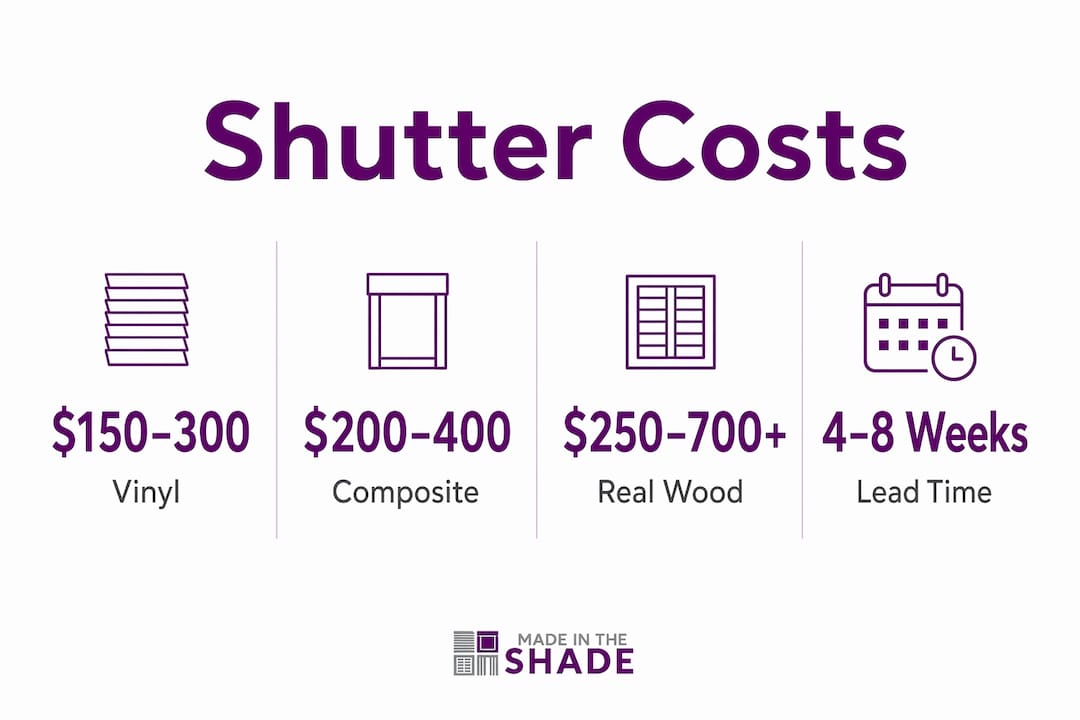
Expect to pay a moderate to high range per window installed for plantation shutters, depending on material, window size, and installation complexity. A typical whole-house project can be a significant investment for most homes in the Philadelphia suburbs. That range may sound wide, but vinyl tends to be the more affordable option, composite offers a mid-range price, and real wood commands a premium.
Here is what matters most before you get a quote:
- Material is the biggest cost driver. Composite (faux wood) hits the best balance of price and durability for most rooms; vinyl is the practical choice for bathrooms and kitchens; real wood commands a premium but adds resale appeal.
- Professional installation adds a notable amount per standard window and is worth every dollar. Measurement errors from DIY attempts routinely cause binding panels, light gaps, and voided warranties.
- Custom shapes and motorization raise the price significantly. Arches, bay windows, and smart-home-compatible motorization can push individual window costs well above the standard range.
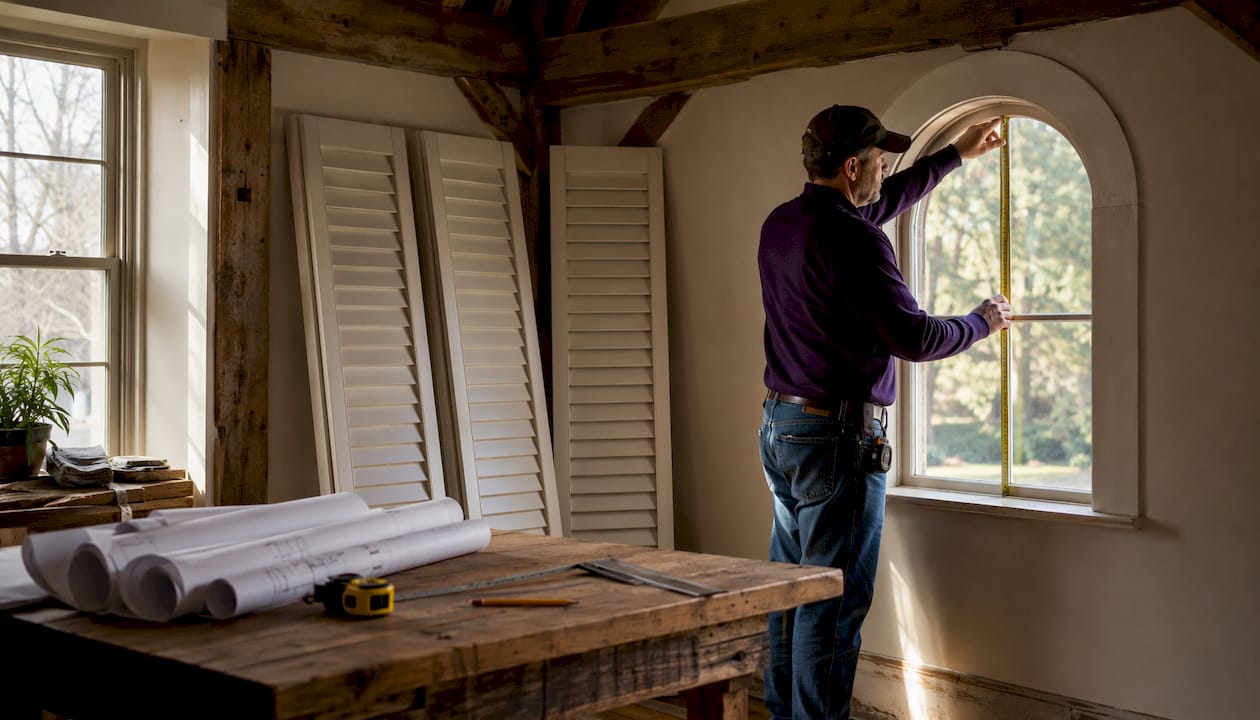
- Schedule a free in-home measurement before committing to any budget. An accurate quote requires someone to measure your actual windows, not a floor plan.
Table of Contents
- How much do plantation shutters cost? A quick price snapshot
- How installers quote plantation shutter prices — and what to watch for
- Estimated budgets by home size and project scope
- What actually moves the price on your quote
- Real wood, composite, or vinyl: which material fits your budget and your home?
- Professional installation vs. DIY: where the math actually lands
- Warranties, lifespan, and whether shutters pay you back
- What a good quote includes — and the questions to ask
- Why professional in-home measurement makes a real difference
- What to expect from ordering to installation day
- Key Takeaways
- What most homeowners get wrong about plantation shutter pricing
- Free in-home measurement for Bucks County and Mercer County homeowners
- Useful sources and further reading
- FAQ
How much do plantation shutters cost? A quick price snapshot
The table below shows typical installed price ranges by material for a standard window. Installed figures typically include an additional charge for labor per window.
| Material | Price per window (installed) | Approx. price per sq ft | Best rooms |
|---|---|---|---|
| Vinyl / PVC | $150–$300 | $15–$25 | Bathrooms, kitchens, rentals |
| Composite / faux wood | $200–$400 | $20–$30 | Living rooms, bedrooms, family rooms |
| Real wood | $250–$700+ | $25–$45 | Living rooms, dining rooms, offices |
Example calculation: A standard 36 × 60-inch window is 15 square feet. At $20 per sq ft for vinyl, that’s $300 in materials plus a $100 installation add, totaling about $400 installed. For composite at $25 per sq ft, that’s $375 for materials plus installation, or about $475 total per window.
Pro Tip: Per-square-foot pricing works well for standard rectangular windows. For specialty shapes like arches, octagons, or wide bay panels, per-window pricing is more meaningful because the labor and custom fabrication costs don’t scale linearly with area.
How installers quote plantation shutter prices — and what to watch for
Most quotes arrive in one of two formats: a flat per-window price or a per-square-foot rate multiplied by measured area. Both are legitimate. The difference is that per-window pricing bundles the frame, hardware, and labor into a single line, while per-square-foot quotes often list those items separately.
A complete quote should break out:
- Frame type (inside mount vs. outside mount, and whether a Z-frame or L-frame is included)
- Panel count and configuration (two-panel, four-panel, bi-fold)
- Louver width (2½-inch, 3½-inch, or 4½-inch — larger louvers cost slightly more per panel)
- Finish (painted white is standard; custom colors, stains, and glazes add cost)
- Hardware (hidden tilt rods vs. center tilt rods; specialty hinges for bi-fold panels)
- Installation labor (itemized per window, not buried in a lump sum)
Hidden costs that catch homeowners off guard include specialty shapes (arches and circles require custom fabrication and add $100–$300 per window), scaffolding for tall windows, trim work to cover gaps between the frame and wall, and motorization. Adding a motorized tilt system compatible with Alexa or other smart-home platforms can add $150–$400 per window depending on the motor type and hub requirements.
A quick example: a homeowner quotes four standard windows at $350 each ($1,400), then adds two arched windows at $550 each ($1,100) and motorization on two panels ($300). The total jumps from an expected $1,400 to $2,800 before any trim work. Knowing these line items in advance prevents sticker shock.
Estimated budgets by home size and project scope
Project size shapes the total cost more than any single window decision, partly because larger orders often qualify for volume pricing.
Small project (2–4 windows): Expect $600–$3,400 depending on material. At this scale, you’re paying full per-window rates with no volume discount. A two-window bathroom job in vinyl might run $800–$900 installed; four living room windows in composite could reach $2,200.
Medium project (8–12 windows): Budget $3,000–$8,500. This is the most common scope for a partial-home install covering main living areas. At this volume, whole-house orders commonly qualify for 10–20% savings compared with buying windows individually, so ask about it explicitly.
Full-house project (15–25 windows): Plan for $6,000–$18,000 or more, depending on material tier and window complexity. A 2,000-square-foot colonial in Bucks County with 18 standard windows in composite typically lands in the $8,000–$12,000 range installed.
Phasing vs. all-at-once: Phasing a project across two seasons saves cash flow but costs more per window and risks slight color variation between production runs. If resale consistency matters to you, doing the whole house in one order is the cleaner move.
What actually moves the price on your quote
Material choice sets the floor, but several other decisions push the number up or down.
- Window size and shape: Larger windows use more material; specialty shapes require custom fabrication and higher labor.
- Louver width: Standard 2½-inch louvers cost less than 3½-inch or 4½-inch options. Wider louvers offer a cleaner view and suit larger windows better, but add to the per-panel price.
- Frame style: A Z-frame (which wraps the window casing) costs more than a basic L-frame but gives a finished, built-in look.
- Number of panels: More panels mean more hinges, more hardware, and more installation time.
- Paint or stain finish: Factory white is the base price. Custom colors, faux finishes, and stains add an additional cost per window.
- Motorization: Smart-home-compatible motorized tilt systems add meaningful cost but are increasingly popular in Bucks County homes with Alexa or Google Home setups. See motorized window options for what’s available.
- Hardware and accessories: Decorative hinges, hidden tilt rods, and specialty pulls add modest but real cost per window.
Material choice is the major cost driver: real wood tends to have the highest upfront cost and perceived resale value, composite offers a good balance of cost and durability, and vinyl is best for moisture-prone areas.
Pro Tip: Choosing 3½-inch louvers over 2½-inch on windows wider than 36 inches gives you a proportionally better look without a dramatic price jump. On narrow windows, 2½-inch louvers are proportionally correct and save money.
Real wood, composite, or vinyl: which material fits your budget and your home?
| Feature | Real wood | Composite / faux wood | Vinyl / PVC |
|---|---|---|---|
| Price per window (installed) | $250–$700+ | $200–$400 | $150–$300 |
| Price per sq ft | $25–$45 | $20–$30 | $15–$25 |
| Installation complexity | Moderate | Moderate | Low–Moderate |
| Durability / lifespan | long | medium | shorter |
| Moisture resistance | Low | High | Excellent |
| Energy performance | Good | Good | Good |
| Best rooms | Living rooms, dining rooms, offices | Most rooms, family homes | Bathrooms, kitchens, rentals |
Real wood shutters carry the highest upfront cost but are also the easiest to repair and refinish. If a louver cracks or a finish chips, a skilled installer can address it without replacing the whole panel. Premium wood shutters are a strong choice for living rooms and dining rooms in older Bucks County homes where the trim detail and grain matter aesthetically.
Composite (faux wood) shutters are the practical pick for most family homes. They handle the humidity swings that come with Northeast summers and damp basements far better than solid wood. Not all composites perform equally, though. Higher-quality engineered composites use wood fibers and resins for dimensional stability, while cheaper versions use fillers that warp in fluctuating temperatures.
Vinyl shutters are exceptionally low maintenance and perform well in bathrooms, kitchens, and rental properties where minimal upkeep is the priority. They won’t match the aesthetic of wood in a formal living room, but in a tiled bathroom they’re the clear practical winner.
Pro Tip: When evaluating composite shutters, ask the supplier for the material’s density rating and moisture-resistance specification. Low-density composites degrade faster in the humidity fluctuations common to the Philadelphia region. A reputable installer will answer that question without hesitation.
Professional installation vs. DIY: where the math actually lands
The appeal of DIY is real. Skipping professional labor saves a notable amount per standard window, which adds up significantly on larger projects. But that math changes quickly when something goes wrong.
Common DIY risks include:
- Measurement errors. Shutters are custom-built to tight tolerances because even new-construction windows can be out of square. A measurement that’s off by ⅛ inch can mean binding panels or visible light gaps.
- Warranty voiding. Most manufacturers require professional installation to maintain the warranty. A DIY install that causes a mechanical failure may leave you paying full replacement cost.
- Obstructions. Crank handles, deep sills, and existing molding require specific frame adaptations that an experienced installer handles routinely and a first-timer often misses.
- Rework labor. Fixing a poorly installed set of shutters often costs more than professional installation would have in the first place.
The breakeven point is roughly this: if you have several windows, the risk of a measurement error negating labor savings is high enough that professional installation is the better investment. For a single bathroom window where you’re confident in your measuring, DIY is a reasonable option. For a living room bay window or an arched transom, it isn’t.
Warranties, lifespan, and whether shutters pay you back
Plantation shutters are one of the few window treatments that genuinely hold their value over time.
- Real wood: long lifespan with proper care; most quality manufacturers offer limited lifetime warranties on the frame and louvers.
- Composite / faux wood: medium lifespan; limited lifetime warranties are common from reputable brands.
- Vinyl / PVC: shorter lifespan; warranties vary more widely, so confirm coverage terms before purchasing.
On energy performance, professionally fitted shutters add a measurable layer of insulation at the window. Paired with well-sealed energy-efficient window frames, shutters reduce heat transfer in both summer and winter. Shutters can contribute to energy savings that offset a portion of their cost over time, particularly in older Bucks County homes with single-pane or drafty windows.
On resale, shutters are one of the window treatment categories that buyers notice and value. They read as a permanent fixture rather than a decorative accessory, which helps at appraisal. Shutters may return a meaningful portion of their cost in resale value for homeowners who install them before listing.
Maintenance costs are low for all three materials. Vinyl and composite need only occasional wiping. Wood requires periodic inspection for moisture damage and, over decades, may need refinishing. That refinishing cost is real but manageable compared with full replacement.
What a good quote includes — and the questions to ask
Getting apples-to-apples quotes requires knowing what to ask for. Use this checklist when requesting bids:
- Itemized material costs by window, including frame type, louver width, and finish
- Installation labor listed separately per window, not bundled into a lump sum
- Production lead time from order to delivery (typically 4–8 weeks for custom shutters)
- Warranty terms in writing: what’s covered, for how long, and whether professional installation is required to maintain coverage
- Removal of existing treatments — confirm whether that’s included or billed separately
- Specialty window pricing — ask for “allowance pricing” on any arched, angled, or oversized windows so you know the upcharge before you commit
- Volume discount terms — if you’re ordering eight or more windows, ask explicitly whether a discount applies
Sample request to send an installer: “Please provide an itemized quote listing material cost per window (with frame type, louver width, and finish), installation labor per window, production lead time, warranty terms, and whether removal of existing blinds is included. If any windows are specialty shapes, please note the upcharge separately.”
Pro Tip: Ask every installer the same set of questions and compare line by line. A quote that looks lower overall may be missing installation labor or using a shorter warranty. Insist on itemized pricing so you’re comparing the same scope across every bid.
Why professional in-home measurement makes a real difference
The difference between a shutter that operates smoothly for 20 years and one that binds within six months usually comes down to the first 10 minutes of the job: the measurement.
Professional measuring accounts for windows that are out of square, sills that aren’t level, and obstructions like crank handles or deep casings that affect frame selection. A trained installer catches these details on the first visit. A homeowner measuring their own windows typically doesn’t know what to look for — and the shutter manufacturer builds exactly what they’re given.
At Made in the Shade Bucks County, every project starts with a free in-home consultation where a design consultant measures each window, identifies any obstructions or specialty conditions, and brings physical samples so you can see materials and louver widths in your actual light. That appointment also covers warranty details, lead times, and an itemized quote — everything you need to make a confident decision without a second trip.
Pro Tip: Bring up any windows with crank handles, deep sills, or existing molding during the consultation. These are the windows most likely to need a custom frame adaptation, and knowing upfront prevents production delays.
What to expect from ordering to installation day
The timeline from first measurement to finished installation typically runs 6–10 weeks for custom shutters. Here’s how it breaks down:
- In-home measurement and quote (Day 1): A consultant measures every window, selects frame types, and provides a written quote.
- Order placement and production (Weeks 1–6): Custom shutters are fabricated to your exact measurements. Standard lead times run 4–6 weeks; specialty shapes or premium wood species can push to 8 weeks.
- Delivery and scheduling (Week 6–8): Shutters arrive at the installer’s facility and are inspected before scheduling the install day.
- Installation (1–2 days depending on project size): A professional crew installs, levels, and adjusts each panel.
Prep checklist for installation day:
- Clear furniture and window treatments from each window area
- Remove any existing blinds or shades in advance if possible
- Confirm your inside vs. outside mount preference with the installer beforehand
- Note any windows with crank handles or hardware that may need to be temporarily removed
Spring and early summer are the busiest scheduling periods in the Philadelphia suburbs. If you’re planning a whole-house project for fall or the holidays, placing the order by late summer gives you the most scheduling flexibility.
Key Takeaways
Plantation shutters cost a moderate to premium amount per window installed depending on material, with composite often offering the best value for many homes and professional measurement being the single most important step in getting a shutter that fits and lasts.
| Point | Details |
|---|---|
| Installed price range | Vinyl typically runs at a moderate range, composite at mid-range, and real wood in the premium range per window installed. |
| Biggest cost driver | Material choice sets the floor; specialty shapes, motorization, and custom finishes push the total higher. |
| Volume savings | Ordering eight or more windows at once commonly qualifies for 10–20% savings versus buying individually. |
| Professional installation | DIY saves a notable amount per window but risks measurement errors, binding panels, and voided warranties. |
| Made in the Shade Bucks County | Offers free in-home measurement and itemized quotes for Bucks County, PA and Mercer County, NJ homeowners. |
What most homeowners get wrong about plantation shutter pricing
The conventional wisdom says to get three quotes and pick the middle one. That advice isn’t wrong, but it misses the more important question: are you actually comparing the same thing across all three bids?
Most homeowners focus on the per-window price and overlook the warranty terms, the composite density, and whether installation labor is itemized or buried. A quote that looks $200 cheaper may be using a lower-density composite that warps within five years, or it may exclude the removal of your existing blinds, or it may cover installation labor only for standard mounts and charge extra for anything else.
The other thing people underestimate is how much the room environment matters. A real wood shutter in a bathroom in a Northeast home is a poor long-term investment regardless of how beautiful it looks on day one. Bucks County summers bring real humidity, and older homes in Doylestown or Newtown often have basement moisture that works its way upstairs. Composite handles that environment; solid wood often doesn’t.
The smarter approach is to decide on material first based on the room, then get itemized quotes that let you compare labor, warranty, and frame type separately from the material price. That’s the comparison that actually tells you which installer is offering real value.
Free in-home measurement for Bucks County and Mercer County homeowners
Figuring out your actual plantation shutters cost starts with one thing: someone measuring your real windows, not a floor plan estimate.
Made in the Shade Bucks County brings the full consultation to your home at no charge. A design consultant arrives with physical samples of wood, composite, and vinyl shutters in multiple louver widths and finishes, measures every window, identifies any specialty conditions, and provides a written itemized quote covering materials, installation labor, lead time, and warranty terms. Cordless and child-safe options are available across all material types, and motorized shutters compatible with Alexa and other major smart-home platforms are available for homeowners who want integrated control.
Made in the Shade Bucks County serves Bucks County, PA and Mercer County, NJ. To get started, request your free consultation and schedule a time that works for you.
Useful sources and further reading
- Plantation Shutters Cost Guide 2026 — Smart Blinds Pro: Per-window price ranges, volume discount data, and ROI estimates used throughout this article.
- Wood vs. Vinyl vs. Composite Shutters Guide — BuyShutterMart: Material comparison data including DIY starting prices and vinyl maintenance characteristics.
- Best Material for Plantation Shutters — Made in the Shade Hilton Head: Room-by-room material recommendations and resale value guidance.
- 5 Essential Factors That Determine Plantation Shutters Cost — Best Blinds and Shutters: Professional measurement standards and installation risk factors.
- Best Material for Shutters — Elizabeth Shutters Insights: Composite density and moisture-resistance guidance; serviceability comparisons by material.
- Plantation Shutters — Made in the Shade Bucks County: Product and service details for shutters in Bucks County, PA and Mercer County, NJ.
- Window Treatment Blog — Made in the Shade Bucks County: Additional how-to articles and local installation guidance.
FAQ
How much should I budget for plantation shutters?
Budget $150–$300 per window installed for vinyl, $200–$400 for composite, and $250–$700 or more for real wood. A typical 10–15 window project often totals $3,000 to $8,500 depending on material and installation complexity.
What is the downside of plantation shutters?
The main downsides are upfront cost and lead time. Custom shutters take 4–8 weeks to produce, and the installed price is higher than most blinds or shades. Real wood also requires more maintenance and performs poorly in humid rooms like bathrooms.
Why are people getting rid of plantation shutters?
Older shutters, particularly low-quality composites or solid wood in humid rooms, can warp, bind, or fade over time. Homeowners replacing them are usually upgrading to higher-density composite materials or switching to vinyl in moisture-prone areas.
Do plantation shutters increase home value?
Yes, in most cases. Shutters read as a permanent fixture to buyers and appraisers, and professionally installed shutters in good condition can recover a meaningful portion of their cost at resale, particularly in the mid-to-upper price range of the Philadelphia suburban market.

