

Expect to pay a range for custom motorized shades per window installed, with a common midpoint for a standard window with a mid-tier motor and professional programming. Ready-made options start closer to $200–$400, but they rarely fit custom openings or include the smart-home integration most homeowners want. Motorization makes the most sense when you have hard-to-reach windows, young children in the home, or an existing smart-home setup with Amazon Alexa or a similar platform. For a line-item breakdown and an on-site estimate from Made in the Shade Bucks County, read on.
At a glance:
- Typical installed range: varies widely per window for custom, professionally installed shades
- Motorization adds a notable premium per window on top of the base shade cost
- Installation labor can add a significant cost per window in this market
- Smart-home programming can add considerable cost per project for full integration
- Made in the Shade Bucks County offers free in-home consultations for Bucks County, PA and Mercer County, NJ homeowners
Table of Contents
- How much do motorized shades cost per window?
- How shade type and window size affect the price
- Battery, hardwired, and solar: how your power choice affects the budget
- What pushes your quote up or down
- Long-term costs, lifespan, and what warranties actually cover
- When motorized shades are worth the extra cost
- How to get an accurate estimate and what to ask installers
- Smart-home compatibility and choosing the right power source
- What Bucks County homeowners should do next
- Key Takeaways
- The case for getting this decision right the first time
- Free in-home consultation for Bucks County and Mercer County homeowners
- Useful sources
- FAQ
How much do motorized shades cost per window?
The most useful number for budget planning is the installed cost per window, because it bundles product, motor, and labor into one figure you can multiply by your window count.
| Project tier | Typical per-window installed cost | What’s included |
|---|---|---|
| Ready-made / DIY | Lower range | Off-the-shelf shade, basic motor, self-install |
| Entry custom | Moderate range | Custom fabric, entry motor, professional install |
| Mid-range custom | Mid to higher range | Premium fabric, quiet motor, smart-home pairing |
| Premium custom | Higher range | Specialty fabric, top-tier motor, full integration |
These ranges reflect market averages drawn from contractor pricing and published installer guides. Your final quote will shift based on window size, power source, and site conditions — which is exactly why an on-site measurement matters before committing to a budget.
Three example project totals:
- Small project (few windows, entry custom): Total cost example provided.
- Typical whole-house (several windows, mid-range): Total cost example provided.
- Large glass wall or great room (few oversized windows, premium): Total cost example provided.
Note on methodology: Ranges above are derived from published installer cost guides and contractor market data. Local on-site measurement by a trained professional is the only way to confirm your actual quote — window dimensions, mounting conditions, and wiring access all affect the final number.
How shade type and window size affect the price
Not every shade style costs the same to motorize. The fabric weight, roller diameter, and headrail complexity all influence which motor tier you need and how much installation time is involved.
By shade style (typical motorized cost per window):
- Roller shades: $300–$550 installed. The most popular choice for motorization — lightweight fabric, compact headrail, and wide motor compatibility keep costs manageable.
- Cellular shades: $300–$600 installed. Excellent for energy efficiency; the honeycomb structure adds slight weight but pairs well with rechargeable battery motors.
- Solar shades: Similar to roller in cost. Fabric openness percentage affects price; tighter weaves for more UV block tend to cost more. Solar shades are a strong choice for south- and west-facing windows in Bucks County summers.
- Roman shades: $350–$700 installed. Fabric folds add weight and require a more robust motor; custom lining options push the price higher.
- Woven wood shades: Typically mid-to-high range. Natural material variation means tighter quality control during manufacturing, which adds cost.
- Dual shades (day/night or blackout layered): Premium pricing. Two fabric layers require either a dual motor or a carefully coordinated single-motor system, and installation time roughly doubles.
By window size:
- Small (under 24" wide): Often at the lower end of any tier; some motors are oversized for very narrow windows, which can actually add cost.
- Standard (24"–48" wide): The sweet spot for most motor systems — best value per window.
- Large (48"–72" wide): Requires a heavier-duty motor; expect $400–$800 installed at the entry-to-mid level.
- Oversized (72"+ or floor-to-ceiling): $500–$1,200+ installed. Side channels, cassette housings, and specialty hardware add meaningful cost.
Specialty systems like cassette housings (which conceal the rolled fabric) and side-channel tracks (which improve light block and wind resistance on patio shades) each add $100–$300 per window on top of base pricing.
Battery, hardwired, and solar: how your power choice affects the budget
Power source is one of the most consequential decisions in a motorized shade project — it affects upfront cost, installation complexity, and what you’ll spend over the next decade.
| Power source | Motor add-on cost | Installation complexity | Ongoing cost |
|---|---|---|---|
| Disposable battery | $125–$175 per shade | Low — no electrical work | Battery replacement ~annually |
| Rechargeable battery | $150–$200 per shade | Low — USB or wand charging | Minimal; recharge every 6–18 months |
| Solar-assisted | $175–$225 per shade | Low-to-medium — panel placement | Very low after setup |
| Hardwired | $175–$250 per shade plus electrician | High — conduit, patching, trim | Effectively zero |
Battery-powered shades are the go-to for retrofits because they avoid electrical work entirely. Hardwiring delivers continuous, maintenance-free power and the most reliable smart-home response times, but it requires an electrician — typically $200–$500 depending on the number of windows and existing wiring access.
Electrician time, conduit runs, patching drywall, and repainting trim can add $500–$1,500 to a hardwired project. Multi-window wiring does benefit from economies of scale: running conduit to six windows in one visit costs far less per window than two separate trips.
Pro Tip: If you’re renovating or building new, plan for hardwiring during construction. Running wire before drywall goes up costs a fraction of what it costs to retrofit later, and hardwired systems provide the most reliable performance for smart-home integration.
What pushes your quote up or down
Before a consultant visits, it helps to know which variables move the needle most. Here’s a practical checklist of the key cost drivers:
- Fabric grade: Entry-level polyester vs. premium solar-control or blackout fabric can double the product cost alone.
- Custom sizing: Non-standard window dimensions require custom fabrication, which adds lead time and cost.
- Motor tier: Budget motors work, but premium motors run quieter, travel more smoothly, and generate fewer service calls over time.
- Controls: A basic remote runs $50–$250; a wall switch adds $100–$400; full smart-hub setup adds $100–$400 for the hub plus $500–$1,500 for programming.
- Number of shades: Volume helps. Ordering 10 shades from one installer typically costs less per unit than ordering 3.
- Mounting complexity: Deep window returns, unusual frame materials, or existing trim that needs to be worked around all add labor time.
- Cassette or fascia housing: Concealing the headrail adds a clean look but costs $100–$300 per window extra.
- Smart-home coordination: Integrating with lighting scenes or HVAC schedules requires additional programming time.
What to gather before a consultant arrives:
- Width and height of each window (measure inside the frame and outside)
- Photos of the window frame, trim, and any existing hardware
- Notes on which rooms get the most direct sun and at what time of day
- Whether you have an existing smart-home hub (Alexa, Google Home, Apple HomeKit)
- Your preferred power option (battery vs. hardwired)
Pro Tip: Knowing your window measurements in advance lets a consultant focus the appointment on fabric selection and motor options rather than basic discovery — you’ll get a more accurate preliminary budget on the spot.
Long-term costs, lifespan, and what warranties actually cover
Motorized shades are a long-term investment, and the sticker price is only part of the picture.
Typical component lifespans:
- Motors: Quality motors from established manufacturers are rated for tens of thousands of cycles. With normal residential use, a well-installed motor should last 10–15 years or more.
- Remotes and wall controls: Generally durable; battery replacement in remotes is the main maintenance item.
- Disposable batteries in shades: Roughly one year of life under typical use. Rechargeable systems extend that interval significantly.
- Smart hubs and bridges: Consumer electronics lifespan of 5–8 years is typical; firmware updates can extend usefulness.
Ongoing costs to plan for:
- Disposable battery replacement: $10–$30 per shade annually for non-rechargeable models
- Hub replacement or firmware-related upgrades: occasional, not annual
- Repair labor if a motor fails outside warranty: varies by installer
Warranty checklist — ask these before you sign:
- Does the manufacturer warranty cover the motor separately from the fabric?
- What is the warranty period for the motor (look for limited lifetime or 5+ years)?
- Does professional installation and programming affect warranty validity?
- Is there a labor warranty from the installer for the first year?
Most products sold through professional installers like Made in the Shade Bucks County carry limited lifetime manufacturer warranties on the fabric and multi-year coverage on motors. DIY-installed or ready-made products typically carry shorter, more limited terms.
Lifespan note: Professional programming that correctly sets motor travel limits protects the motor from strain at the top and bottom of travel. Skipping this step is one of the most common causes of premature motor failure.
When motorized shades are worth the extra cost
Motorization adds a significant percentage premium to the cost of a comparable manual shade project. That premium is easy to justify in specific situations and harder to defend in others.
Use cases where motorization clearly pays off:
- Hard-to-reach windows: Skylights, clerestory windows, or windows above a staircase are genuinely difficult to operate manually. Motorization isn’t a luxury here — it’s the practical solution.
- Child safety: Corded shades pose a documented strangulation risk. Cordless and motorized options eliminate that hazard entirely, which is reason enough for many families.
- Energy control: Scheduling shades to close during peak afternoon sun hours reduces cooling load in a way that manual operation rarely achieves consistently. Paired with a smart thermostat, this can meaningfully reduce summer energy bills. For more on combining shading with HVAC efficiency, thermostat-driven strategies are worth reviewing.
- Whole-home automation: If you already use Alexa or Google Home for lighting and climate, adding motorized shades to the same ecosystem costs less in programming time and delivers a genuinely unified experience.
- Accessibility needs: For homeowners with limited mobility, motorized shades move window treatment operation from a physical task to a voice command or app tap.
A simple ROI example: A south-facing great room in Bucks County gets direct sun from roughly noon to 5 PM in July. Scheduling solar shades to close at noon and reopen at 5 PM reduces the peak cooling load on that room. Even modest reductions in air conditioning runtime add up over a summer. The energy-saving potential of properly scheduled shading is real, though exact savings depend on your home’s insulation, HVAC efficiency, and window area.
The hybrid approach: You don’t have to motorize every window at once. Starting with the highest-impact openings — the great room, primary bedroom, or that one impossible skylight — lets you experience the benefits before committing to a whole-house project.
How to get an accurate estimate and what to ask installers
A well-prepared homeowner gets a better quote. Here’s a numbered checklist to bring to any installer appointment.
Questions to ask every installer:
- Do you measure each window on-site before quoting, or is this a ballpark estimate?
- Which motor tier are you quoting — entry, mid, or premium — and what’s the difference in noise and longevity?
- What power source are you recommending for my situation, and why?
- Is smart-home programming included, or is it quoted separately?
- Which platforms does this system support (Alexa, Google Home, Apple HomeKit, Matter)?
- What does the manufacturer warranty cover, and what does your installation warranty cover?
- What is the lead time from order to installation?
- Can you provide references from similar projects in this area?
What a good installer should inspect on-site:
- Window frame condition and mounting surface (drywall, wood, metal stud)
- Available depth for inside-mount vs. outside-mount
- Wiring access and proximity to outlets or junction boxes
- Interference with existing trim, crown molding, or plantation shutters
- Whether multiple windows can share a single wiring run
Pro Tip: Ask for an itemized quote that separates product cost, motor cost, installation labor, and programming. A single lump-sum quote makes it nearly impossible to compare bids fairly or understand where your money is going.
Smart-home compatibility and choosing the right power source
Motorized shades today are compatible with Amazon Alexa, Google Home, and Apple HomeKit. The Matter interoperability standard is increasingly relevant: it allows devices from different manufacturers to communicate without a proprietary hub, which simplifies setup for homeowners who already have a mixed smart-home ecosystem.
Practical rules of thumb for power choice:
- Building new or doing a major renovation? Hardwire. Running wire before drywall costs a fraction of retrofitting later, and hardwired systems deliver the most reliable smart-home performance.
- Retrofitting an existing home with finished walls? Battery or rechargeable battery is the practical choice. No electrical work, no patching, and modern rechargeable motors perform well for most residential applications.
- South- or west-facing windows with good sun exposure? Solar-assisted motors are worth considering — the panel keeps the battery topped off with minimal maintenance.
Smart-home compatibility notes:
- Amazon Alexa and Google Home: The most widely supported platforms; most mid-to-premium motorized shade systems include native integration or a compatible bridge.
- Apple HomeKit: Supported by a narrower but growing list of motors and hubs; confirm compatibility before purchasing.
- Matter: Reduces or eliminates the need for a proprietary hub in many setups. If you’re building a new smart-home ecosystem, prioritizing Matter-certified devices simplifies long-term management.
Pro Tip: Before purchasing a hub or bridge, check whether your preferred shade motor is already Matter-certified. If it is, you may be able to skip the proprietary hub entirely and control shades directly through your existing Alexa or Google Home setup.
What Bucks County homeowners should do next
For most homeowners in Bucks County and Mercer County, the decision comes down to three factors: which windows cause the most frustration to operate manually, whether child safety is a priority, and how much of the home you want to automate at once.
Recommended next steps:
- Identify your three highest-priority windows (hardest to reach, most sun exposure, or most frequently used).
- Decide on your preferred power source based on whether you’re renovating or retrofitting.
- Note your existing smart-home platform so your installer can confirm compatibility upfront.
- Schedule a free in-home consultation with Made in the Shade Bucks County for an on-site measurement and itemized preliminary budget.
Bucks County’s older colonial and farmhouse-style homes often have non-standard window dimensions that make custom sizing necessary. The free consultation takes the guesswork out of measuring and gives you real numbers before you commit.
Key Takeaways
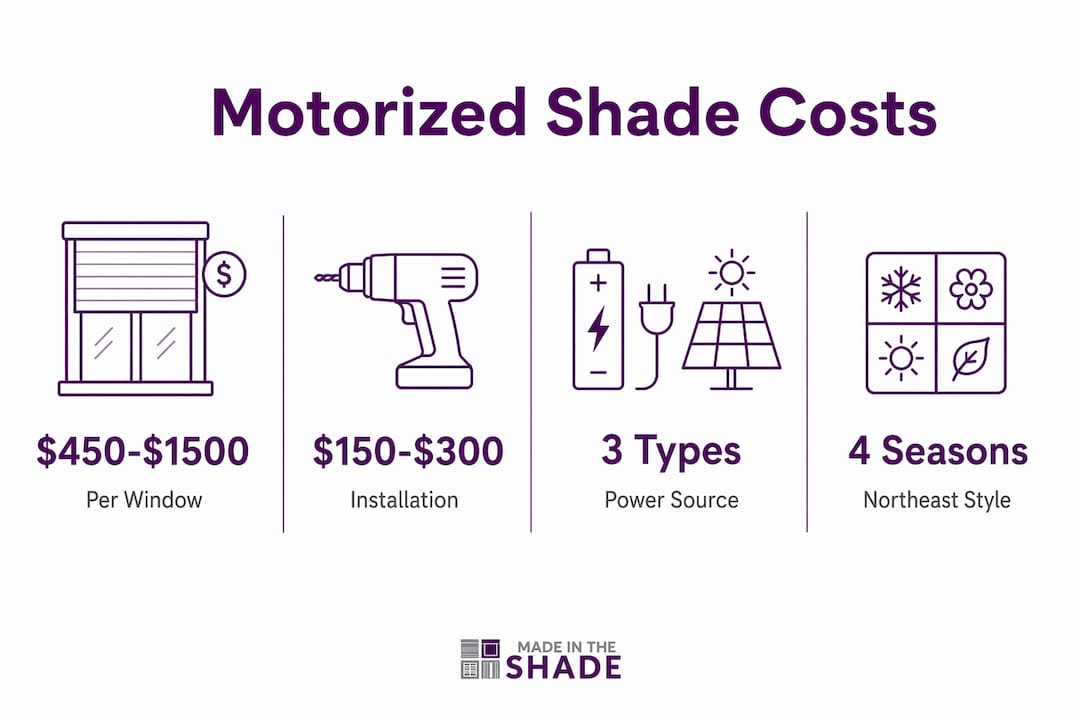
Custom motorized shades typically cost $450–$1,500 per window installed, with motor choice, fabric grade, and smart-home programming as the three largest variables determining where your project lands in that range.
| Point | Details |
|---|---|
| Per-window installed range | Expect $450–$1,500 for custom professional installation; ready-made options start at $200–$400. |
| Motorization premium | Motorization adds $150–$500 per window for basic systems; high-end, fully integrated setups can exceed $1,000 per window. Full smart-home integration can add $500–$1,500 per project. |
| Power source matters | Battery suits retrofits; hardwiring is best for new builds or renovations for reliability and low maintenance. |
| Hybrid approach works | Motorizing priority windows first spreads cost and lets you experience benefits before a whole-home commitment. |
| Made in the Shade Bucks County | Offers free in-home consultations with on-site measurement and itemized quotes for Bucks County, PA and Mercer County, NJ homeowners. |
The case for getting this decision right the first time
Motorized shades are one of those purchases where the upfront decision quality determines whether you’re happy for 15 years or frustrated within 18 months. The homeowners who regret the investment almost always made the same two mistakes: they chose the cheapest motor available, and they skipped professional programming.
A budget motor that rattles, hesitates, or loses its smart-home connection every few weeks isn’t a convenience — it’s an annoyance that costs more to fix than the savings were worth. The motor quality premium is real and worth paying. Similarly, professional programming that correctly sets travel limits protects the motor from mechanical stress at the endpoints of travel, which is where most premature failures originate.
The other underrated factor is power source planning. Homeowners who retrofit battery-powered shades and then decide two years later they want hardwired reliability end up paying twice — once for the battery system and once for the electrical work. If there’s any chance you’ll want hardwired performance, the time to plan for it is before the walls close up.
Motorization isn’t right for every window in every home. But for the windows that matter most — the ones you struggle to reach, the rooms where afternoon sun makes the space unusable, the home with young children — the functional value is straightforward and the math works.
Free in-home consultation for Bucks County and Mercer County homeowners
Getting an accurate motorized shades budget starts with someone actually measuring your windows and seeing your space. Made in the Shade Bucks County brings the samples and expertise directly to your home — no showroom visit required. A design consultant arrives with fabric samples, motor options, and the tools to measure every window precisely, then delivers a clear, itemized quote covering product, motor, installation, and programming.
Service is available throughout Bucks County, PA and Mercer County, NJ only. The consultation is completely free, with no obligation. Whether you’re ready to motorize three windows or planning a whole-home project, the in-home appointment gives you real numbers and a clear picture of your options. Visit the custom window treatments page or go directly to the window motorization page to schedule your free consultation.
Useful sources
The following sources supplied pricing data, technical compatibility information, and installation guidance used throughout this guide:
- Pricing ranges and installation labor: Alluring Window — Motorized Shades Cost Guide — primary source for per-window installed ranges, motor add-on costs, and control hardware pricing.
- Motorization premium and hybrid approach: Cascade Window Fashions — Are Motorized Window Coverings Worth the Extra Cost? — source for motorization add-on range and phased-project guidance.
- Power source trade-offs: Charleston Custom Shutters — Motorized Shades Pros, Cons & Fit — battery vs. hardwire guidance for retrofit and new-build scenarios.
- Battery lifespan and ongoing costs: Stoneside — How Much Do Motorized Window Shades Cost? — disposable battery life intervals and total cost of ownership notes.
- Energy scheduling and cooling load: Solaris Shading — Motorized Shades vs. Manual Blinds — scheduled shading and cooling demand reduction.
- Smart-home compatibility and Matter: Alluring Window — How Do Motorized Shades Work? — platform compatibility (Alexa, Google Home, HomeKit) and Matter standard overview.
- Cost by window size and type: HomeGuide — How Much Do Motorized Blinds Cost? — size-based and style-based installed cost ranges.
- Local motorization services: Made in the Shade Bucks County — Window Motorization — local service details, smart-home compatibility, and free in-home consultation model.
FAQ
How much do motorized shades typically cost?
Custom motorized shades typically cost $450–$1,500 per window installed. Ready-made options start at $200–$400 but rarely include professional installation or smart-home programming.
Are motorized shades worth the cost?
For homeowners with hard-to-reach windows, young children, or an existing smart-home setup, the answer is generally yes. The premium is harder to justify for small, easily accessible windows where manual operation works fine.
How much does professional installation add to the price?
Installation labor typically runs $150–$300 per window in this market, covering motor testing, remote pairing, travel-limit programming, and smart-home integration setup.
How long do motorized shades typically last?
Quality motors are rated for tens of thousands of cycles and realistically last 10–15 years with proper installation and programming. Disposable batteries in battery-powered systems need replacement roughly once a year; rechargeable systems extend that interval considerably.
Do motorized shades work with Alexa and other smart-home platforms?
Yes. Most mid-to-premium motorized shade systems are compatible with Amazon Alexa, Google Home, and Apple HomeKit. The Matter standard is increasingly supported and can reduce or eliminate the need for a proprietary hub in many setups.

